Article
An Economic Hitman Is Running Canada
The author's verdict on Mark Carney: a banker who never built anything, never worked for a paycheque, moving from bank to bank and country to country. Here are the facts the verdict rests on.
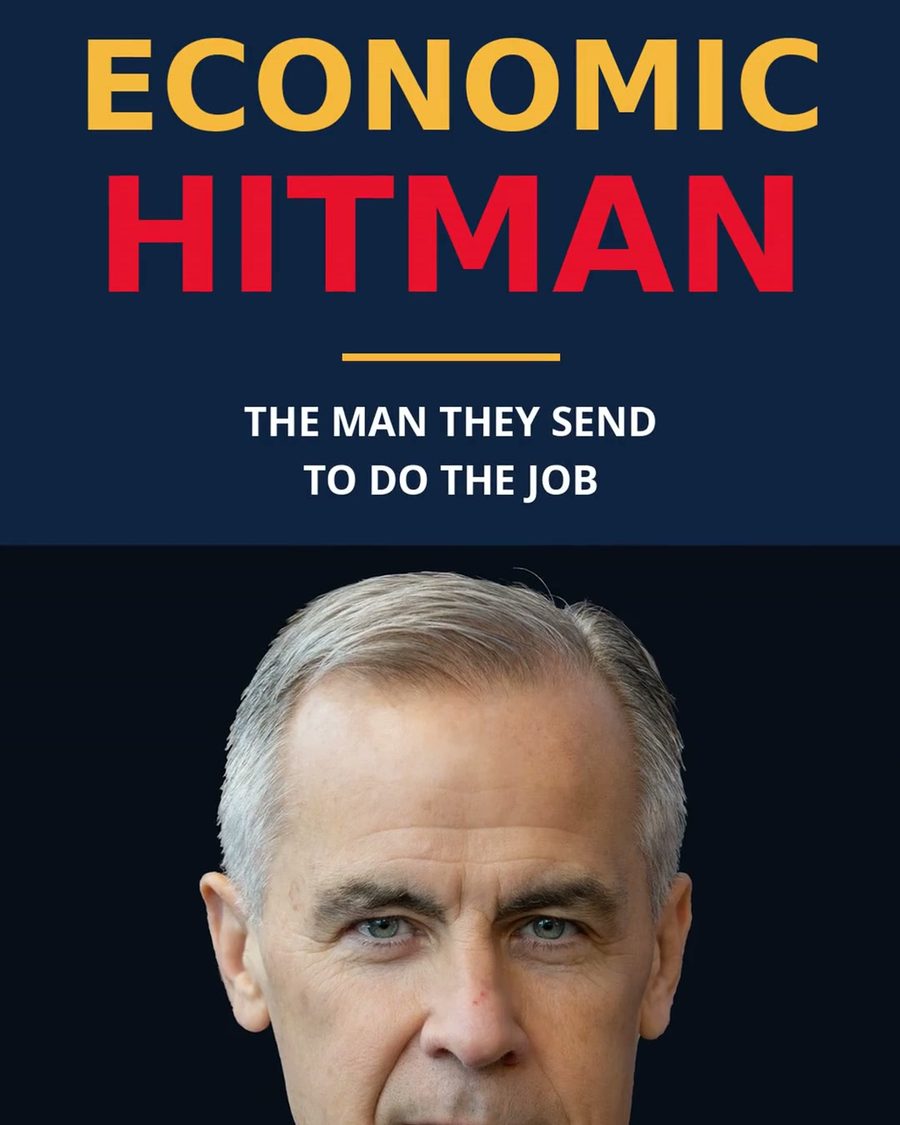
Watch the 60-second video version on YouTube →
A banker who never built anything is running Canada. He never worked for a paycheque. He was never elected. He is the man they send to do the job. An economic hitman.
That is the verdict of Remus Bogdan, the author of this project. It is an opinion, and this article labels it as one from the first line. But a verdict is only worth reading if you can see the facts it rests on. So here they are, every one of them checked: the career, the numbers, and the Canada that career now governs. Read the facts. Then judge the verdict for yourself.
What "economic hitman" means
The phrase comes from John Perkins' book "Confessions of an Economic Hit Man", published in 2004. Perkins used it for men who, in his account, moved between banks, corporations and governments, arranging loans and deals that served powerful interests while ordinary people paid the price. Remus Bogdan applies the term to Mark Carney as his own conclusion. No court, inquiry or official body has called Carney an economic hitman. The word is a judgement, and it belongs to the author, not to the record.
What belongs to the record is the career path. That is where this article starts.
Bank to bank, country to country
Mark Carney spent 13 years at Goldman Sachs, working in London, Tokyo, New York and Toronto. He became Governor of the Bank of Canada in February 2008, just as the global financial crisis hit, and served until June 2013. Then he became Governor of the Bank of England, from July 2013 to March 2020, the first non-Briton ever to run it in its more than 300-year history.
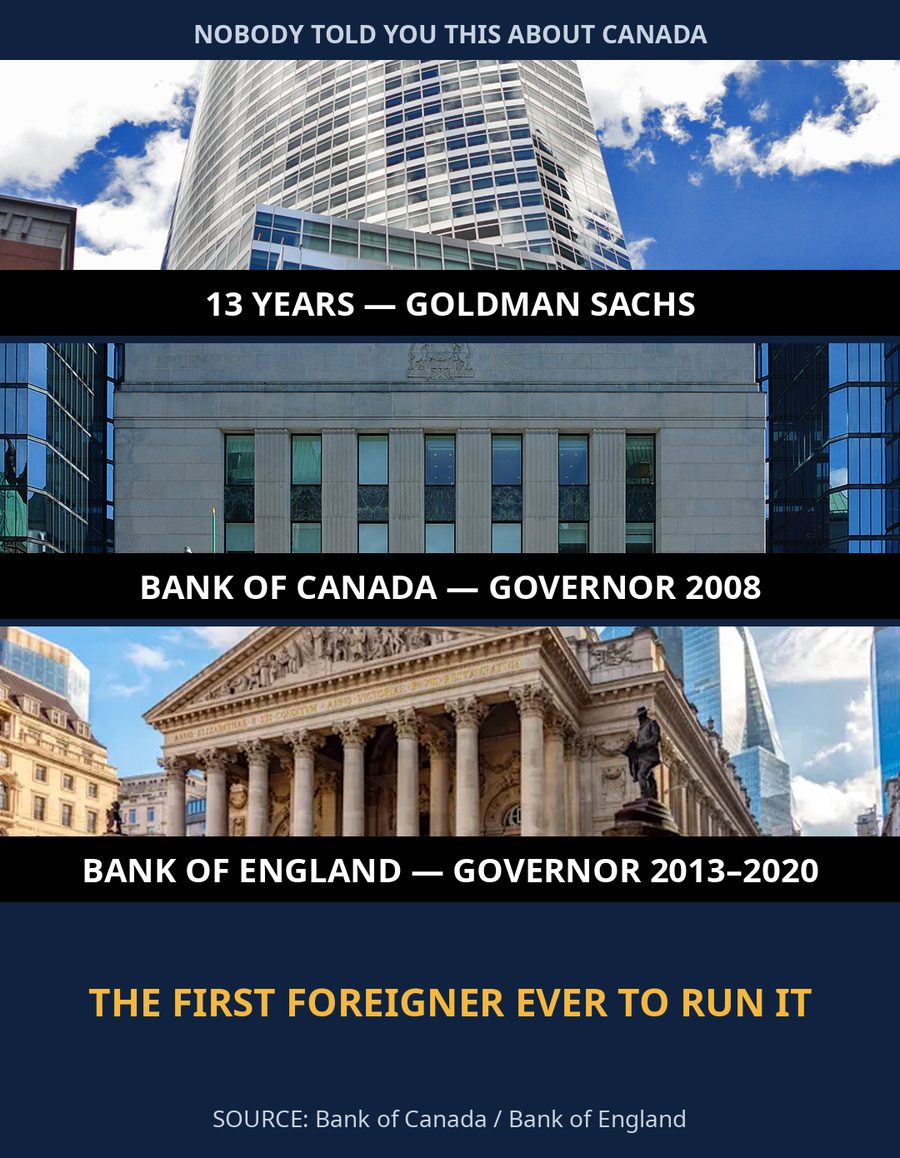
After London, he moved to Brookfield Asset Management as vice-chair, took a role at Bloomberg, and served as the United Nations Special Envoy on Climate Action and Finance. Then, in September 2024, Justin Trudeau made him his economic adviser. Six months later, on March 14, 2025, he was sworn in as prime minister of Canada, the first prime minister in the country's history who had never held elected office. No Canadian had ever voted for him. He was not even a member of Parliament.
He did face voters soon after. In the general election of April 28, 2025, he led the Liberals to 169 of 343 seats and was elected as the member of Parliament for Nepean, Ontario. A fair account says that too. But the path to the top job ran through banks and boardrooms and a party vote, not through an election.
The record he brought with him
What did that career produce? In Canada, his time at the Bank of Canada during the 2008 crisis is widely praised. In Britain, the record is weaker, and the numbers are his own. In his report to the UK Parliament's Treasury Committee in February 2020, Carney wrote that British business investment had risen just 1.25% since the Brexit referendum, while in the rest of the G7 it had grown 12% on average. Growth slowed through his final years there, reaching 1.3% in 2019, the weakest year since 2012 on current data.
Before the Brexit referendum, on May 12, 2016, Carney warned that a vote to leave the European Union could possibly include a technical recession. The recession never came. In the first full quarter after the vote, the British economy grew 0.6%. To be precise about what he did: he warned of a risk, he did not promise a recession. But the warning was wrong either way, and it is part of the record he brought to Canada.
One line in the video needs honest handling here. It says Carney "never worked for a paycheque." Taken literally, that is not true: he was a salaried employee at Goldman Sachs and at both central banks. What the line means, in the author's words, is that he never built a business, never ran a shop, never did the kind of work most newcomers do when they arrive. The article keeps the author's meaning and drops the literal claim, because the facts matter more than the slogan.
What he is doing with the job
The verdict is not only about the past. It is about the present. Budget 2026, tabled on November 5, 2026, projects a federal deficit of $62.3 billion for 2026–27. That is money the government spends beyond what it takes in, borrowed against future taxes. At the same time, the federal government's own count found more than 65,000 people homeless on a single night in 2025, 59% more than in 2020–2022. Carney's plan is to put Canada on a path to end homelessness within 10 years, with $11.2 billion in Budget 2026. Ten years. Ten more winters at minus 30 for people sleeping in tents.
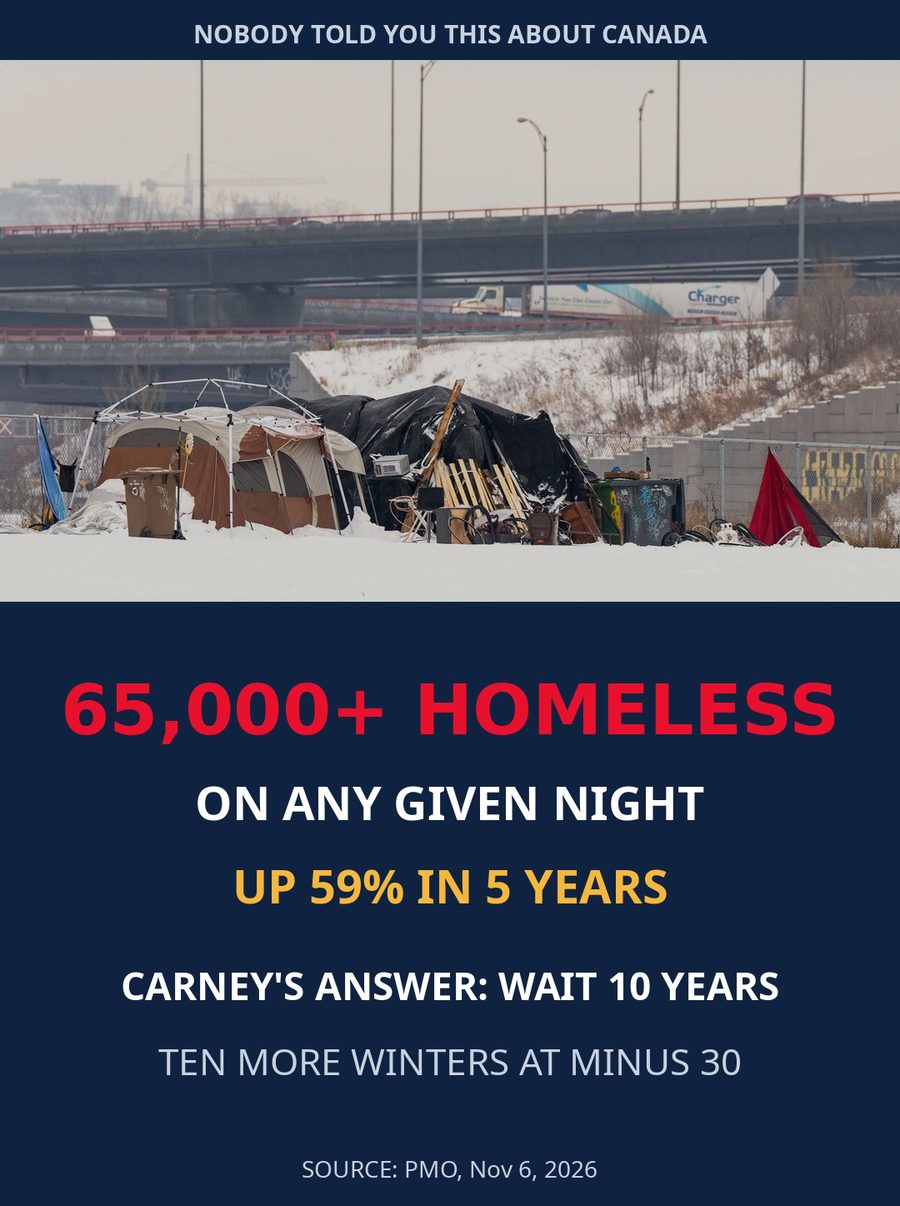
And while homelessness rose at home, Canada committed more than $26 billion in assistance to Ukraine since 2022, including over $14 billion in direct financial support and $8.5 billion in military assistance. The author's argument is that this money could have ended homelessness in Canada, and that Carney chose a war instead. That is his argument. The numbers beside it are facts, and you can weigh them yourself.
The verdict, in full
Here is the author's case, put plainly. A man who spent his life inside banks and global institutions now runs a country. He reached the top without facing a voter. He governs a country with a $62.3 billion deficit, 65,000 homeless people, and billions sent abroad while people sleep in tents at home. The agenda, in the author's view, is not Carney's own. He is the man they send to do the job. An economic hitman.
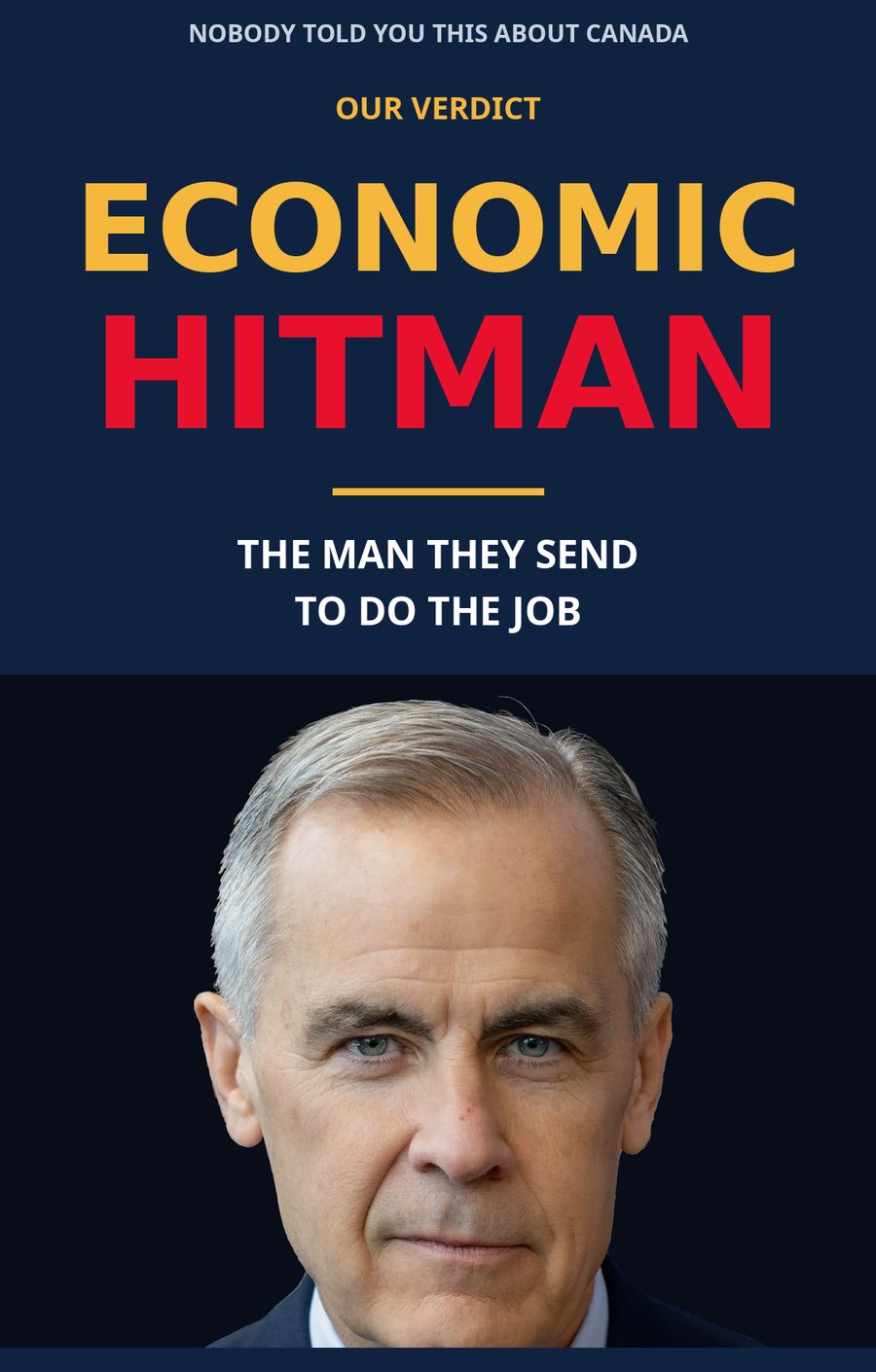
You do not have to agree. Reasonable people look at the same career and see a respected central banker who steered two countries through crises and won a democratic election. Others look at the same facts and see exactly what the author sees. The purpose of this article is not to make you agree. It is to make sure that when you decide, you decide on facts that are checked and labelled honestly: what is proven, what is argued, and where the line sits between the two.
He moved from bank to bank, from country to country, spending money that is not his. And now he is Prime Minister.
So do you still want to come to Canada?
We welcome you, arms wide open. More than 65,000 people are homeless on a single night. But before you choose, know the truth. That is why this project exists: to help you make a clear choice. Check the sources below. Then decide.
Sources
- Wikipedia — Mark Carney: Goldman Sachs, Bank of Canada, Bank of England, PM Mar 14, 2025
- TruthBacked — Mark Carney: adviser Sep 2024, leadership 85.9%, sworn in Mar 14, 2025
- UK Parliament Treasury Committee — Carney's Feb 2020 report: business investment +1.25% vs G7 +12%
- Advanton / World Bank — UK annual GDP growth 2014–2019
- ONS — UK GDP, Q3 2016: growth continued after the Brexit referendum
- Scotiabank Economics / Elections Canada — 2025 election: Liberals 169, Conservatives 144
- Department of Finance Canada — Budget 2026: $62.3 billion projected deficit
- Government of Canada — Everyone Counts 2025: 65,000+ homeless on a single night, up 59%
- Government of Canada — Response to Parliament, Sep 21, 2026: over $26 billion committed to Ukraine