Article
Canada Owes $56,432 in Your Name. You Haven't Even Arrived Yet.
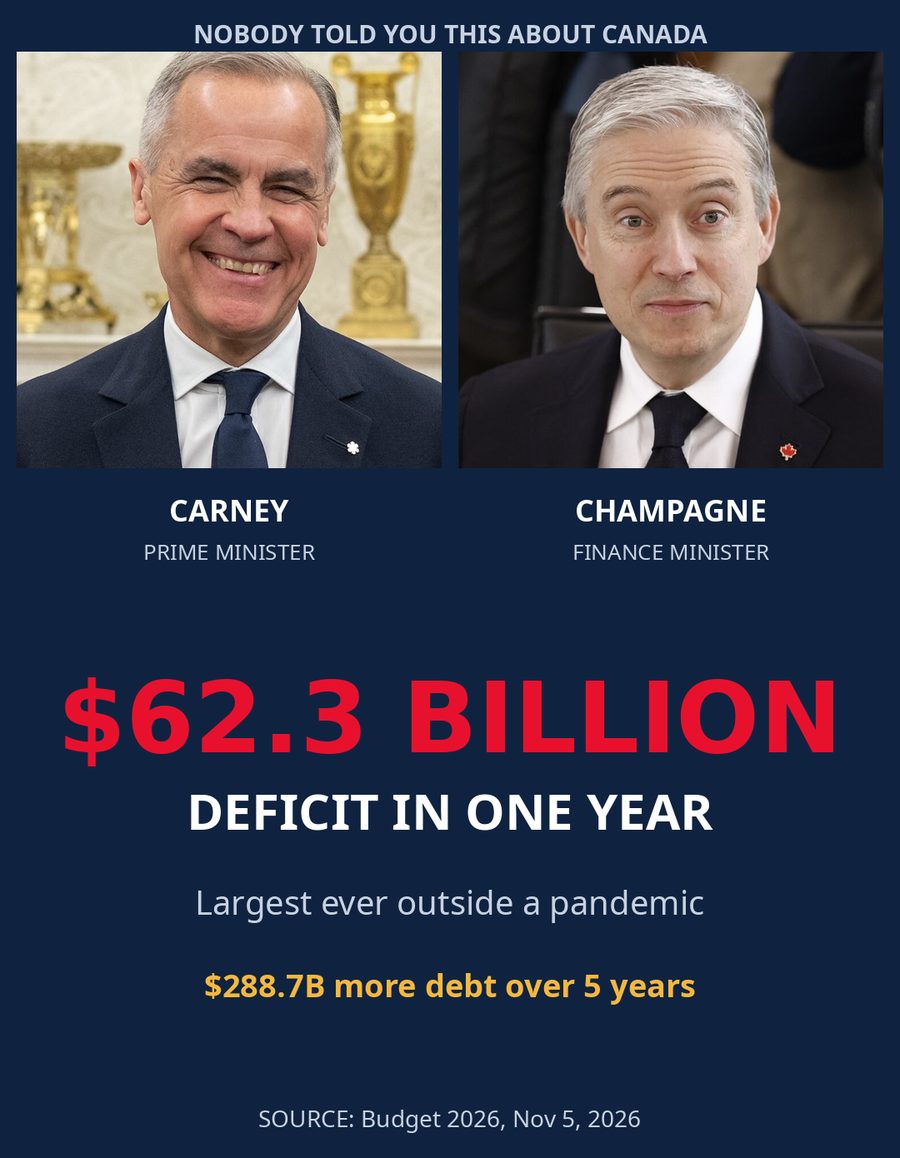
Budget 2026 ran a $62.3 billion deficit. Here is what that means for the money in your pocket.

Watch the 60-second video version on YouTube →
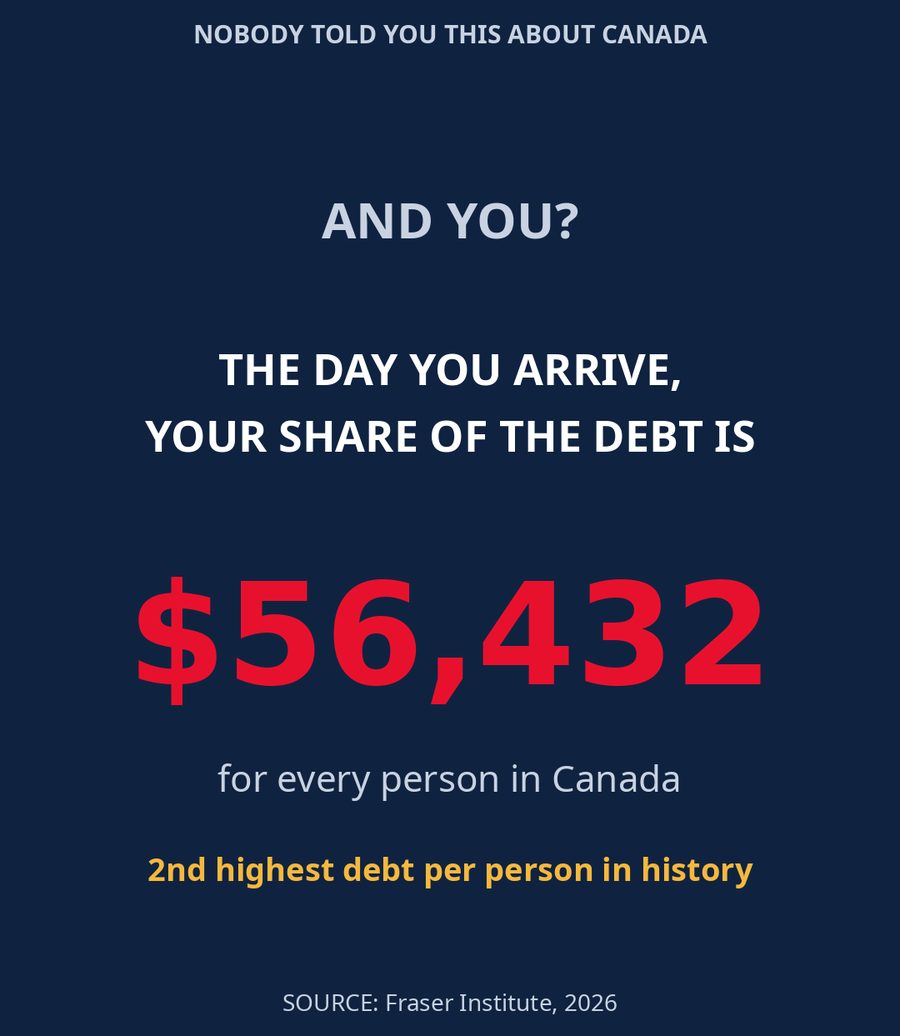
You have not landed yet. You have not earned a dollar in Canada, paid a dollar of Canadian tax, or used a single Canadian service. But Canada already owes $56,432 in your name. That is the share of the federal debt for every person in the country — and it is the second-highest it has ever been.
The budget in one paragraph
On November 5, 2026, Finance Minister François-Philippe Champagne tabled Budget 2026. The deficit for 2026-27 is $62.3 billion — the largest ever in a year without a pandemic. The budget projects four more years of deficits after that: $62.5 billion, $57.6 billion, $53.4 billion and $52.9 billion. Added together, that is $288.7 billion of new debt over five years, on top of what is already owed.
Federal debt rises from about $1.31 trillion to about $1.59 trillion by 2030-31, on the budget's own count. And the debt itself costs money: the interest Ottawa pays on what it owes climbs from $53.5 billion a year to $85.5 billion by 2030-31. That is money that cannot go to hospitals, roads, or the services a newcomer will need. The Fraser Institute's January 2026 study put the result in one number: $56,432 of federal debt for every person in Canada, second only to the pandemic year of 2021.
Where some of the money went
Since February 2022, Canada has committed more than $25.5 billion in aid to Ukraine, including $8.5 billion in military assistance, according to the government's own February 2026 release. Another $2 billion in military assistance is budgeted for 2026-27. That is Canada's choice to make, and many Canadians support it. But a newcomer should know what happened next, because it is part of the country they are moving to.
In November 2025, Ukraine's anti-corruption police, NABU, made public an investigation called Operation Midas. Investigators say at least $100 million moved through a kickback scheme at Energoatom, the state nuclear company, where contractors paid 10 to 15 per cent of their contract value or were blocked from payment. The alleged ringleader is Timur Mindich, a businessman who was President Zelenskyy's business partner before the presidency. He left Ukraine before the searches began.
The case kept climbing. Andriy Yermak, the president's chief of staff, resigned in November 2025 and was charged in May 2026 with laundering about 460 million hryvnias — roughly $10.5 million — through a luxury housing development. A former energy minister was detained. Ministers resigned. One line matters for honesty: President Zelenskyy himself has not been charged. NABU's director, Semen Kryvonos, said on May 12, 2026, that the president "has not been and is not currently a subject of the pretrial investigation." And nothing in the public record shows Canadian aid money going into this scheme. The point is not that your taxes were stolen. The point is that billions flow out while the debt at home keeps growing.

The car companies got $50 billion in promises
It is not only Ukraine. Between 2022 and 2024, Ottawa and the provinces promised roughly $50 billion in subsidies and tax credits to car companies to build batteries in Canada — the Parliamentary Budget Officer put the figure at $43.6 billion for Volkswagen, Stellantis-LG and Northvolt alone, with Honda's package taking it past $50 billion. Most of it was structured as payments that only flow when batteries are actually made. Here is what happened to the factories.
Northvolt, the Swedish battery maker, went bankrupt in March 2025. Its Quebec plant never got past site preparation, and Quebec lost its $270 million equity stake outright — though the province largely recovered a separate $240 million land loan. Honda's $15 billion project in Alliston, Ontario, was indefinitely suspended on May 14, 2026; no public money had been paid, because the payments were tied to milestones the project never reached. Stellantis sold its Brampton assembly plant to defence maker Roshel on November 9, 2026 — a story we tell in full in a companion article. Volkswagen's plant in St. Thomas is still under construction, but its first batteries have slipped from 2027 to 2029. The one project actually making battery modules in Canada in 2026 is the Stellantis-LG plant in Windsor.
What it costs you before you even arrive
The national debt is the background. The foreground is your own money, and the numbers there are just as blunt. If you come to study, Statistics Canada puts average international undergraduate tuition at $41,746 a year for 2025/26 — $49,802 in Ontario, $18,867 in Newfoundland and Labrador. Canadian students pay $7,734 on average for the same seat. Before you even apply, the government requires you to show you can support yourself: since September 1, 2026, a single applicant outside Quebec must show $23,448 in living funds, on top of tuition and travel.
Then there is rent. The national average asking rent was $2,036 a month in October 2026. In Toronto, the average asking rent across all unit types was $2,593, and a one-bedroom averaged $2,229. At the usual rule that rent should take no more than 30 per cent of your gross income, that one-bedroom needs roughly $89,000 a year before tax. Add tuition, rent, food and transport, and the book puts a full year in Canada, all in, at somewhere between $30,000 and $60,000 — before you earn a dollar.
And if you come to work in a regulated profession, the gate has its own price. An Educational Credential Assessment from WES now costs $264, plus delivery and tax — and it only scores your degree for immigration. It does not let you practise. Licensing is a separate gate, run by the profession itself, with its own exams and fees. We explain that gate in detail in our article about Nigerian degrees in Canada.
What the debt means for you
The $56,432 is not a bill that will arrive in your mailbox. Nobody will ask you to pay it on landing. What it means is slower and more ordinary: a government paying $85.5 billion a year in interest has less room for everything else, and the Fraser Institute's own warning is that the bill eventually lands as higher taxes, fewer services, or some combination of both. You will live inside that arithmetic for years.
None of this means Canada is a bad choice. It is still a wealthy country, and millions of newcomers have built good lives here. It means the choice should be made with the real numbers in front of you — the debt, the tuition, the rent, the gate — not with the brochure version. That is the whole point of this guide.
Check before you pay anyone
Verify a school against IRCC's list of PGWP-eligible programs before you pay tuition. Verify an immigration consultant against the CICC public register before you pay for advice — only a licensed consultant, a lawyer, or a Quebec notary may legally charge for it. And check a landlord's deposit demand against provincial law: in Quebec a landlord cannot ask for a security deposit at all, and in Ontario the only deposit allowed is last month's rent.
Sources
- Budget 2026 — $62.3B deficit, $288.7B over five years
- Fraser Institute, Examining Federal Debt in Canada by Prime Ministers Since Confederation, 2026 — $56,432 per person
- Canada.ca, Feb 24, 2026 — $25.5B+ aid to Ukraine, $8.5B military
- OCCRP — Operation Midas, Yermak charged, $100M+ scheme
- RFE/RL, May 12, 2026 — NABU chief: Zelenskyy not a subject of the investigation
- Kurums, Canada EV Battery Plants scorecard — ~$50B promised, Northvolt, Honda
- Statistics Canada tuition data 2025/2026, via Settle Canada — $41,746 average international undergraduate tuition
- IRCC proof of funds $23,448 (from Sept 1, 2026), via VisaMet
- Rentals.ca & Urbanation National Rent Report, Oct 2026 — national $2,036, Toronto one-bedroom $2,229
- WES ECA fee C$264 in 2026, via GoFarGlobal