Article
Canada, the Literacy Mirror
Canada is the most educated country in the OECD — and one in five adults reads at the lowest level. Meanwhile, only 41% of foreign-trained doctors work as doctors.
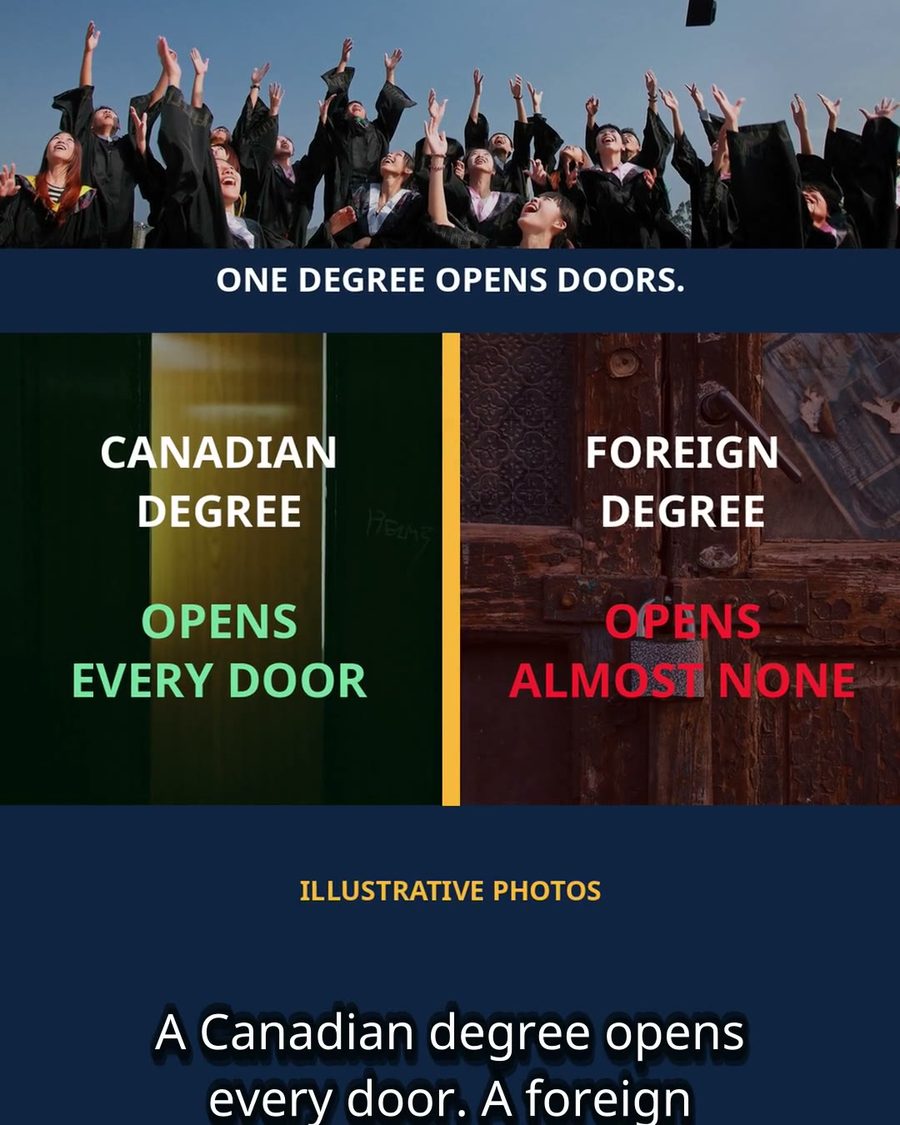
Watch the 60-second video version on YouTube →
A Canadian degree opens every door. A foreign degree opens almost none. Now look at the other side of the mirror.
You studied for years. You earned the degree, passed the exams, worked in the profession back home. Then you arrive in Canada and the door stays locked. The degree is real. The training is real. The patients you treated, the bridges you designed, the classes you taught — all real. And none of it opens the door.
That is one side of the mirror. The other side is what Canada says about itself. Hold both sides up at once, and the picture is hard to look away from.
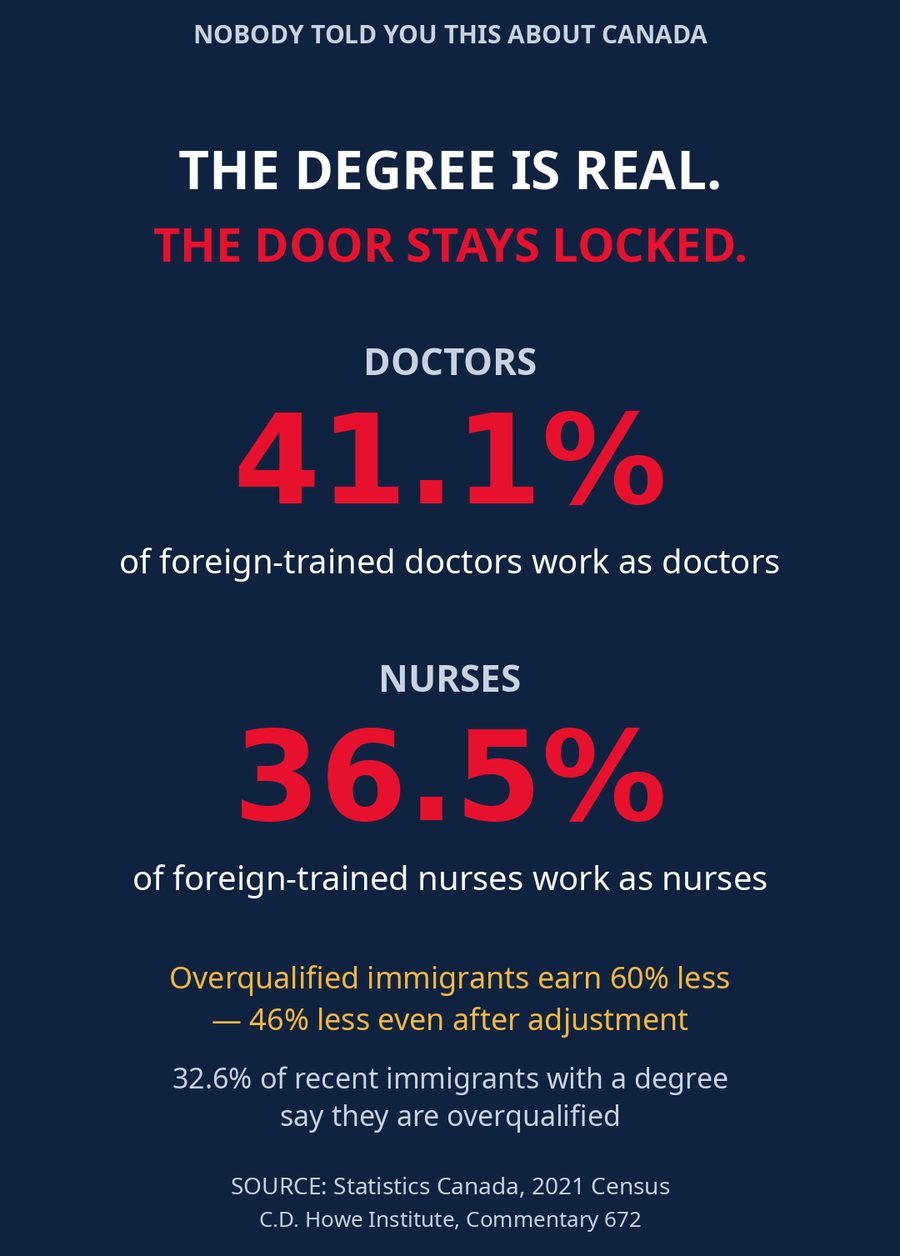
The degree is real. The door stays locked.
Only 41.1 percent of foreign-trained doctors work as doctors in Canada. Only 36.5 percent of foreign-trained nurses work as nurses. Those are Statistics Canada's numbers from the 2021 Census, and they describe people who already hold the qualifications — people Canada says it desperately needs. Meanwhile, about nine in ten Canadians with nursing or medical degrees work in their field. The gap is not about the degree. It is about where the degree comes from.
The waste spreads far beyond medicine. Close to one in three recent immigrants with post-secondary qualifications — 32.6 percent — report being overqualified for their jobs, compared with 19.1 percent of Canadian-born workers. Overqualified immigrants earn 60 percent less than matched workers, and 46 percent less even after adjusting for the usual differences, according to the C.D. Howe Institute's Commentary 672. The pay gap is not a rounding error. It is nearly half a working life, priced down.
Part of the lock is licensing. Roughly one job in five in Canada is regulated by law — doctors, nurses, engineers, accountants, teachers, licensed trades — and requires a permit from a provincial body. An Educational Credential Assessment, the ECA you may have paid for, only tells immigration roughly what your degree is worth on the Canadian scale. It does not authorize you to practise. Licensing is a separate gate, run by the profession's regulator, and for medicine the bottleneck is a residency seat, not knowledge: exams can be passed and still no residency secured.
The other side of the mirror
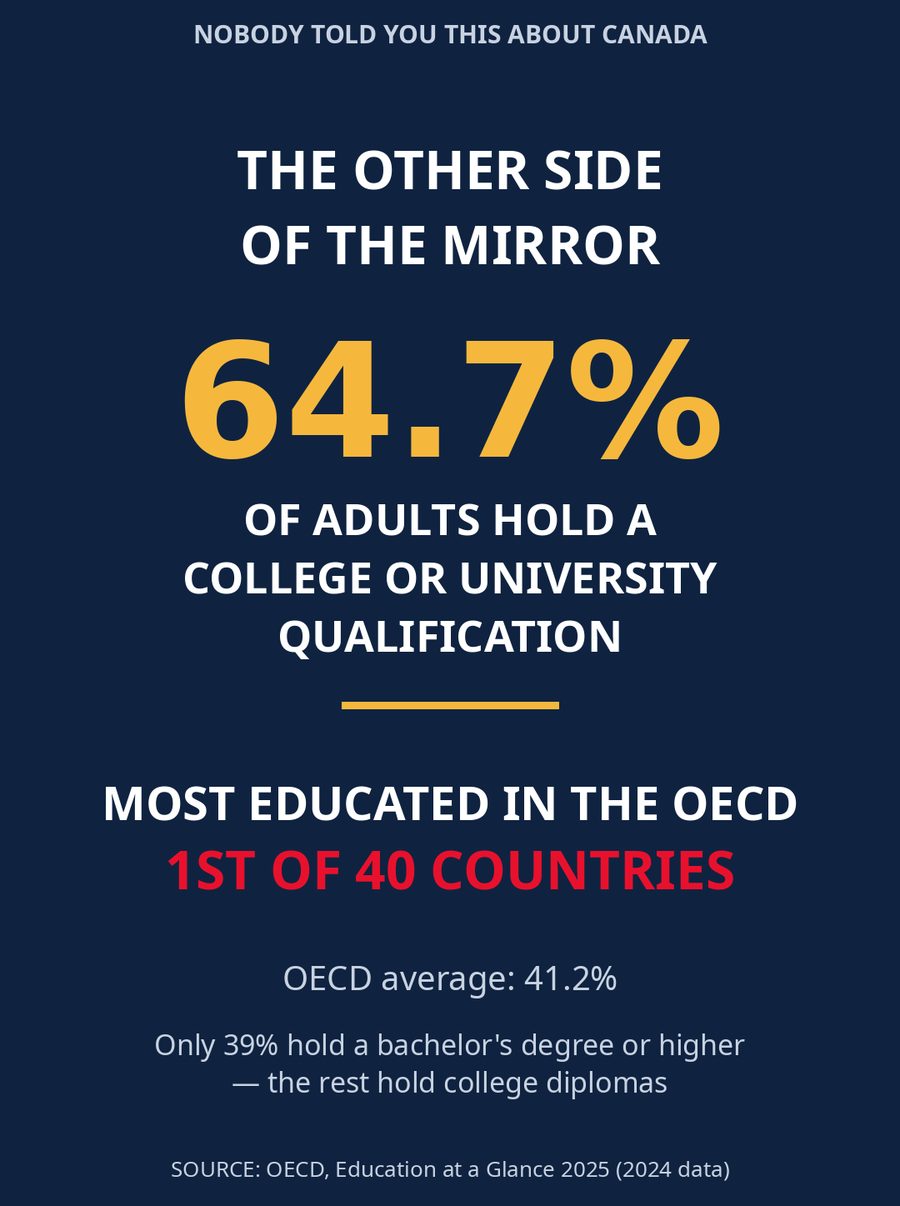
Now the other side. Canada is the most educated country in the OECD — 64.7 percent of adults aged 25 to 64 hold a college or university qualification, first of 40 countries, against an OECD average of 41.2 percent. That is the headline Canada leads with, and it is true.
Read it one line further and it softens. Only about 39 percent hold a bachelor's degree or higher; the rest hold college diplomas. A qualification is not the same as a degree, and a diploma is not the same as a doctorate. The headline counts them all the same.
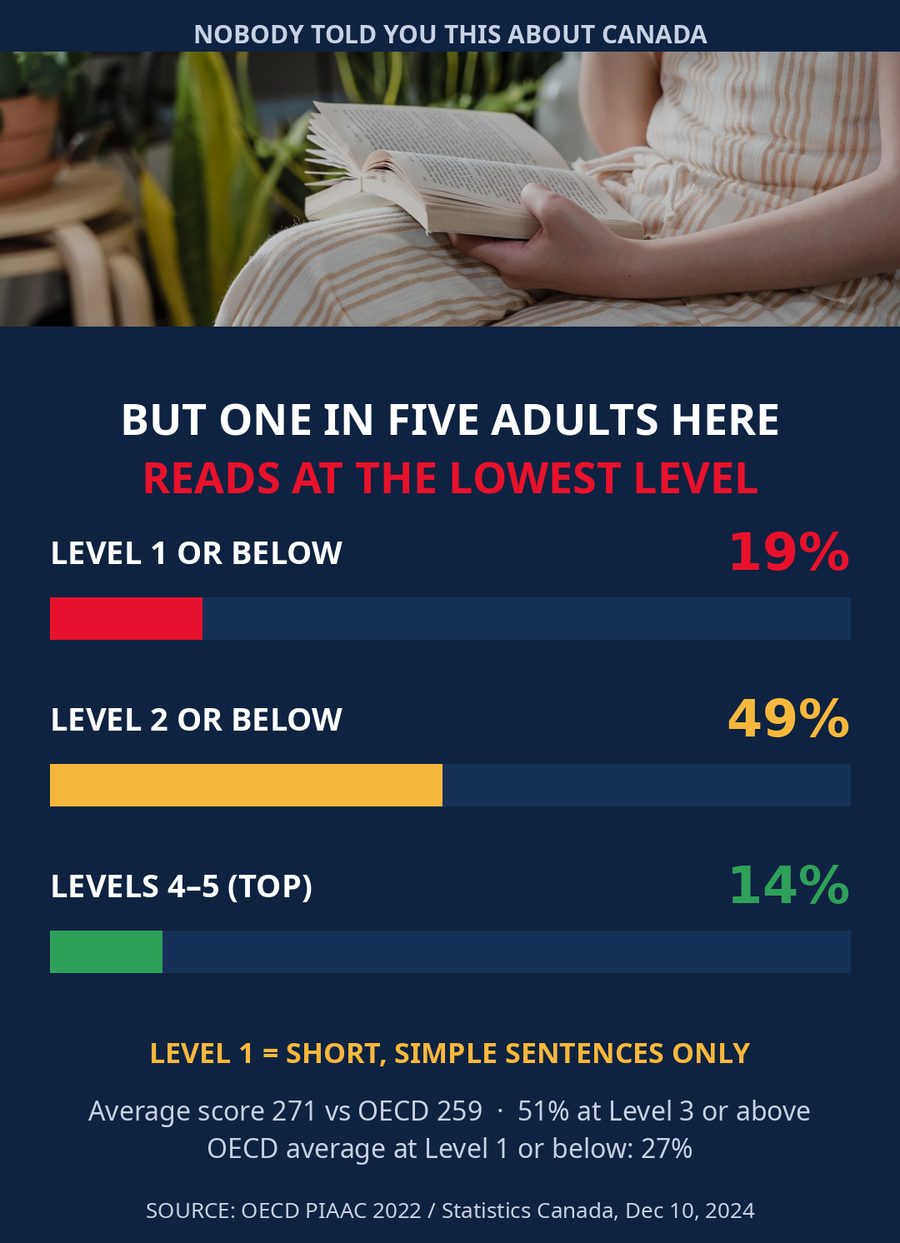
One in five adults reads at the lowest level
Then comes the number nobody puts on a poster. In the OECD's Survey of Adult Skills (PIAAC 2022), 19 percent of Canadian adults aged 16 to 65 read at Level 1 or below — the lowest measured levels. Another 30 percent read at Level 2. Put together, 49 percent of adults read at Level 2 or below. Only 14 percent reach the top levels, 4 and 5. Canada's average literacy score, 271, sits above the OECD average — and still, nearly half the adult population reads below the level the modern job market expects.
That is not illiteracy. Level 1 means short, simple sentences: a person at Level 1 can read a basic text and find one piece of information in it. Level 2 means longer texts with some distracting information. These are real skills, and they are not nothing. But they are a long way from the reading a university degree is supposed to certify. The survey, it should be said, covered the 10 provinces only — the territories and on-reserve communities were not included.
The gap runs through education itself. Adults with a bachelor's degree or higher average a literacy score of 293. Adults with a high school diploma or less average 246. That is the spread inside one country, inside one education system — and it sits next to the foreign-trained doctor who cannot get a residency and the foreign-trained nurse working as a care aide.
That is not illiteracy. Level 1 means short, simple sentences. And still, their degree opens every door. Yours opens almost none.
What the mirror actually shows
The mirror does not show that Canadian graduates cannot read. It shows that a credential and a skill are two different things — and that Canada's system trusts its own credentials completely while trusting nobody else's at all. A Canadian diploma opens doors even when the reading behind it is Level 2. A foreign medical degree opens almost none even when the doctor behind it has ten years of practice. The door is not opened by what you can do. It is opened by where your paper was stamped.
That is not a reason to stay home. It is a reason to arrive with your eyes open — and to check the licensing gate for your profession before you come, not after you land. Contact the provincial regulator for your occupation. Ask what the requalification path actually costs, in money and in years. For some professions it is months. For medicine it can be years with no guaranteed seat at the end. Know which one you are walking into.
Before you come, check the gate
Find your profession's provincial regulator and ask for the requalification path in writing: exams, bridging programs, supervised practice, and the real timeline. Check whether your occupation is regulated at all — four jobs in five are decided by the employer, not by a licence. And if you are already in Canada and locked out, look for the settlement services and mentoring programs in your city: they are free, and they exist precisely because this lock is so common.
Canada needs the people it keeps out. Its hospitals are short of doctors and nurses. Its job postings ask for skills that newcomers already have. The mirror shows a country that is the most educated in the OECD by its own count, and still cannot use the education that arrives at its airports. That is the actual truth about the life of immigrants in Canada — and it is better to know it before you pack than after you land.
Sources
- Statistics Canada, The Daily, Nov 30, 2022 (2021 Census) — 41.1% of foreign-trained doctors, 36.5% of nurses work in their field
- C.D. Howe Institute, Commentary 672 (Dec 2024) — overqualification and the 60% / 46% pay gap
- Statistics Canada — job mismatch among immigrants (Apr 7, 2026) — 32.6% overqualified
- OECD, Education at a Glance 2025 — Canada country note — 64.7% tertiary attainment
- Statistics Canada, The Daily, Dec 10, 2024 — PIAAC 2022 results
- Statistics Canada, Table 37-10-0259-01 (PIAAC 2022) — level distribution: 19.3% / 29.7% / 51.0%
- Decoda Literacy Solutions — Insights from Canada's Adult Literacy Survey — PIAAC scope and findings