Article
Canada Votes With a Pencil. The Banker Won.
On April 28, 2025, Canadians chose their government on paper ballots, marked with a pencil. Here is how the system works, who won, and what the country looks like now.
Watch the 60-second video version on YouTube →
You saved for years to move to Canada. And this is how they choose the man in charge. With a pencil. A pencil you can erase. The banker won.
On April 28, 2025, Canadians went to vote in a general election. The country still votes the way it has for generations: on paper, by hand, with a pencil. This article explains how that system actually works, who won, and what the winning government has done since, in numbers you can check.
The pencil
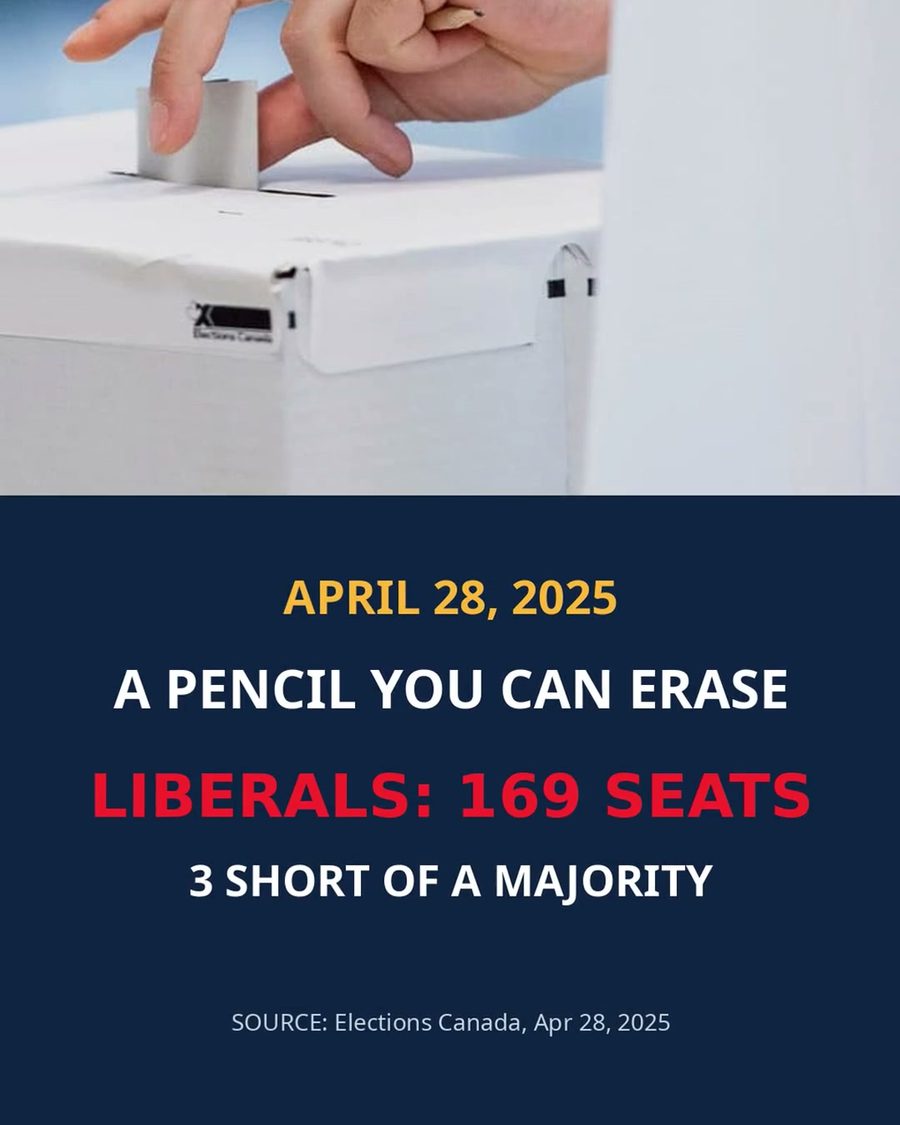
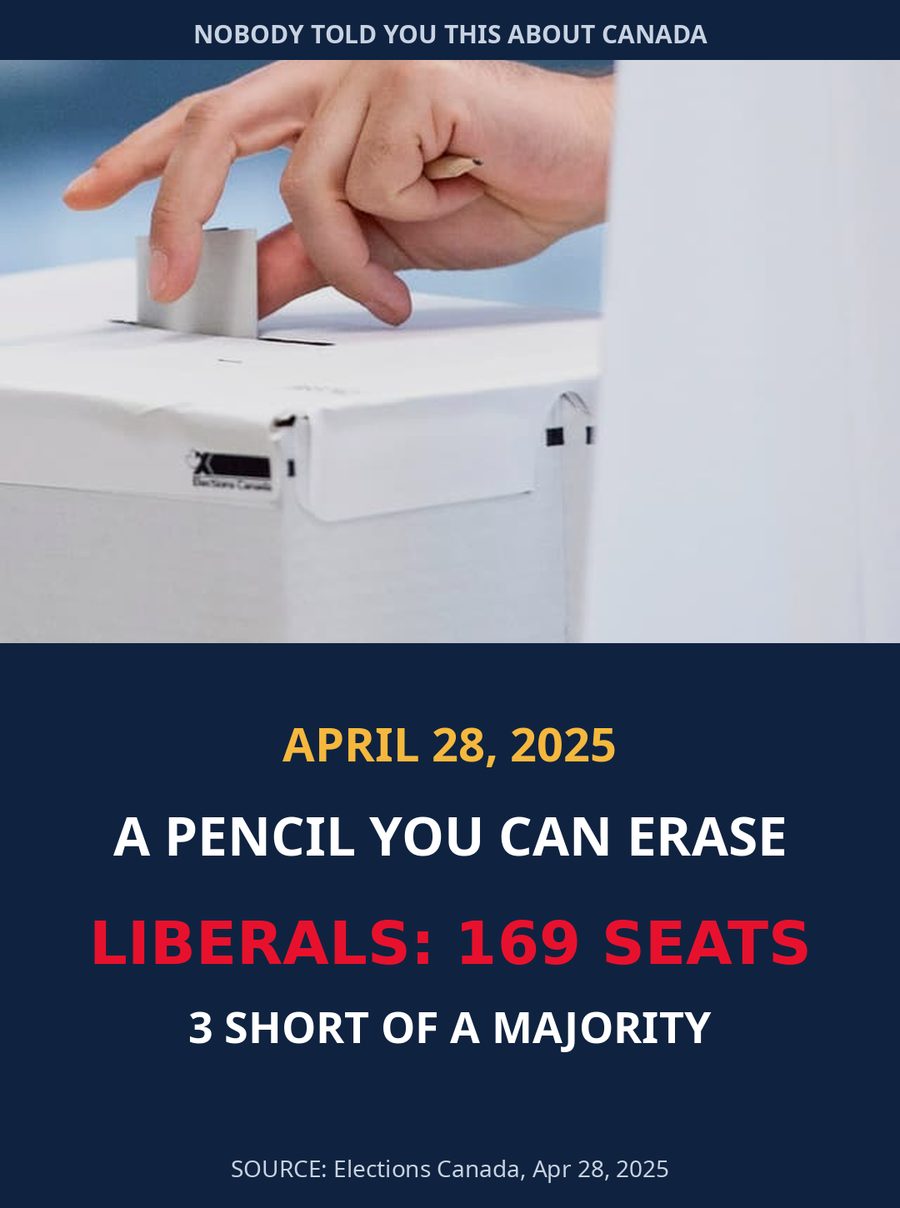
Here is what happens when a Canadian votes. You walk into a polling station and you are given a paper ballot. It lists the candidates in your riding, with a circle beside each name. In the voting compartment there is a black-lead pencil. You mark one circle, fold the ballot, hand it back, and drop it in the box. That is it. No machine. No screen. No app.
Elections Canada, the independent agency that runs federal elections, says it uses pencils because pens can dry up or leak, which could spoil a ballot. The law requires poll workers to provide black-lead pencils, but you are free to bring a pen and use that instead. Your vote counts either way.
What about the worry in the video, that a pencil mark can be erased? Elections Canada has answered that claim directly and calls it false. Ballots are printed on special paper, each one carries a serial number and the initials of an election worker, and ballots stay sealed until counting time. Counting is done by hand, by pairs of paid election workers, in front of witnesses who do not work for Elections Canada, usually the candidates' own representatives. The system is built on paper, seals, serial numbers and witnesses, not on trust in the pencil.
You can still find the pencil strange. Much of the world votes electronically now. Canada looked at that and kept the paper. Elections Canada says paper ballots and hand counting remain the best approach for efficiency and security. Whether you agree is your call. But the question the video asks deserves the official answer next to it, and now you have both.
Who won
The election was called on March 23, 2025, days after Mark Carney became prime minister without ever having held elected office. It was the first election fought on a new map of 343 seats. Turnout was 69.5% of eligible voters, the highest since 1993.
Carney's Liberals won 169 seats with 43.76% of the vote, three short of the 172 needed for a majority. Pierre Poilievre's Conservatives won 144 seats with 41.31%, and Poilievre lost his own riding of Carleton. The Bloc Québécois won 22 seats, the NDP won 7, and the Greens won 1. The Liberals formed their third straight minority government, and Carney himself was elected as the member of Parliament for Nepean, Ontario.
The minority did not last. In April 2026, opposition members crossing the floor and by-election wins gave the Liberals a majority. So the government that won 169 seats with a pencil now governs with a majority it did not win at the ballot box. That is how Canada's parliamentary system works: a government holds power as long as it commands the confidence of the House, however the seats move.
And now? The deficit
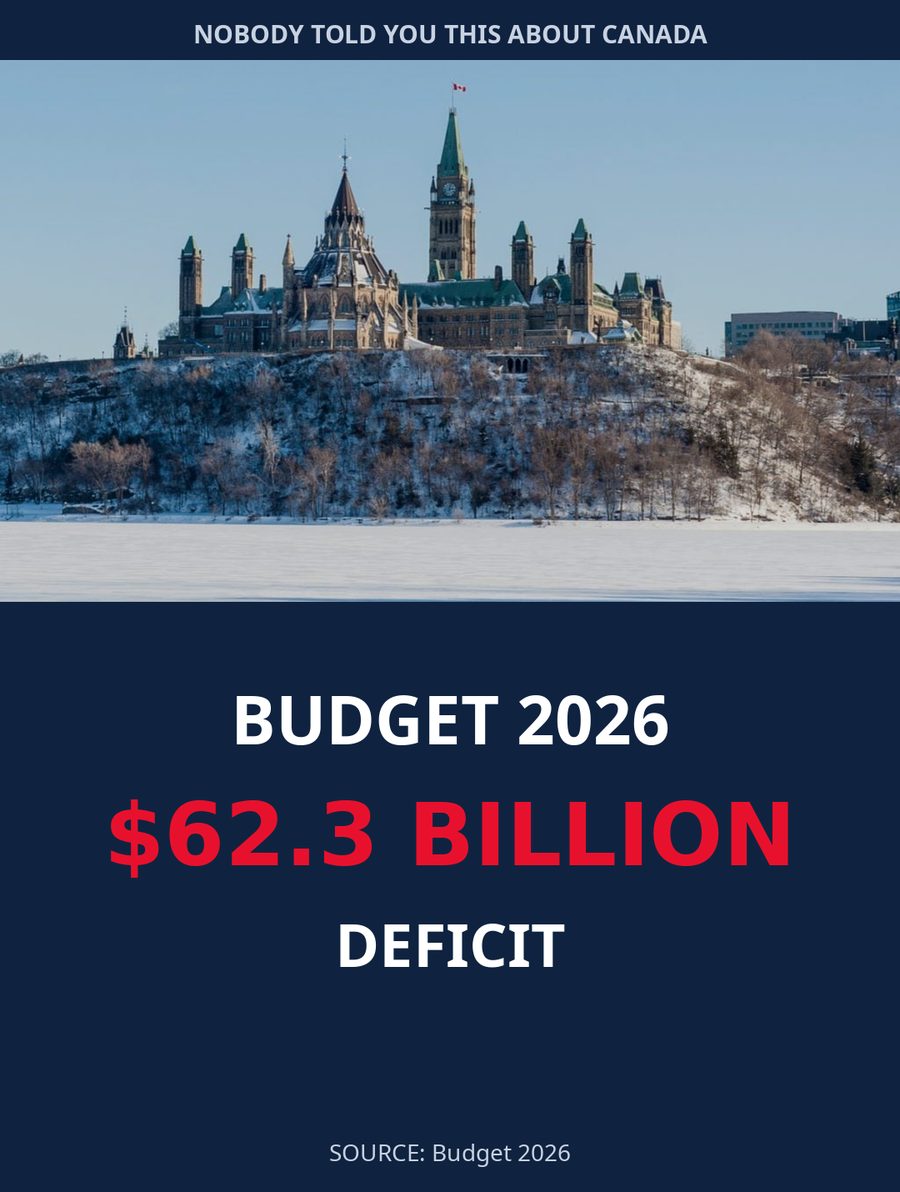
Budget 2026, tabled on November 5, 2026, by Finance Minister François-Philippe Champagne, projects a federal deficit of $62.3 billion for 2026–27, about 1.8% of the economy. The government projects deficits of $62.5 billion the year after, falling only slowly to $52.9 billion by 2030–31. Federal debt stays near 40% of the economy. The independent Parliamentary Budget Officer had projected $63.3 billion for 2026–27 in its October outlook, close to the government's number.
Two things to keep straight. First, these are projections, not final results. The last audited year, 2025–26, came in at a deficit of $39.316 billion. Second, a deficit means the government spends more than it takes in, and the difference is borrowed. That borrowed money is repaid, with interest, out of future taxes, including taxes paid by newcomers.
65,000 homeless
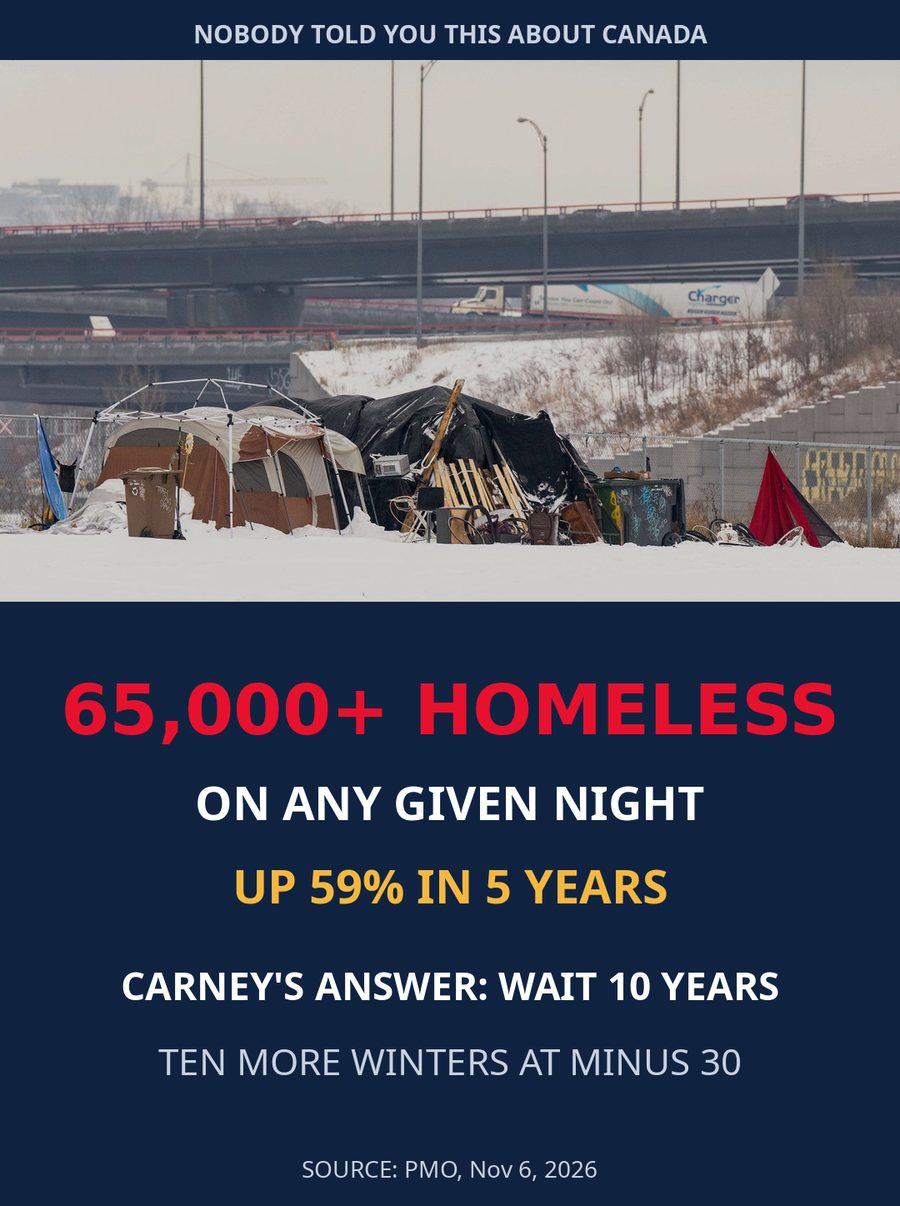
While the government borrows, the federal government's own count found more than 65,000 people homeless on a single night in 2025, across 75 communities. That is 59% more than in 2020–2022. Of those counted, 36,716 people were in shelters, 17,620 were unsheltered, and 4,763 of the unsheltered were living in encampments, in tents, in a country where winter temperatures fall far below freezing.
Carney's answer is a plan to put Canada on a path to end homelessness within 10 years, with $11.2 billion in Budget 2026. Ten years means ten more winters. The Parliamentary Budget Officer estimated in May 2024 that reaching the federal homelessness target would take an extra $3.5 billion a year. Keep that number in mind for the next section.
$26 billion went to Ukraine
Since Russia's full-scale invasion in 2022, Canada has committed more than $26 billion in assistance to Ukraine, according to the government's own response to Parliament in September 2026. That includes over $14 billion in direct financial support and $8.5 billion in military assistance. The military training mission, Operation UNIFIER, has been extended to 2029, and in September 2026 Canada and Ukraine signed a declaration for a 100-year partnership.

Remus Bogdan's argument is that this money could have ended homelessness in Canada, and that the government chose a war instead. That is his argument, not a verified fact. But the numbers beside it are facts, and readers can weigh them: $26 billion committed abroad since 2022, against a Parliamentary Budget Officer estimate of $3.5 billion a year extra to reach the homelessness target at home. You do not need anyone to tell you what to think about that comparison. The numbers speak plainly enough.
What this means for you
None of this is a reason to stay home or to come. It is a reason to decide with your eyes open. You are moving to a country that votes on paper with a pencil, counts by hand, and is governed by a man who reached the top job without facing a voter, then won an election with a minority that later became a majority. You are moving to a country that borrows $62.3 billion in a year, counts 65,000 homeless on a single night, and sends billions abroad. All of that is true at the same time. Know it before you choose.
A $62.3 billion deficit. 65,000 homeless. And $26 billion sent to Ukraine. This is Canada now.
Sources
- Scotiabank Economics / Elections Canada — 2025 election: Liberals 169, Conservatives 144, turnout 69.5%
- Elections Canada — Voting tools and services: pencils at polling stations
- The Canadian Press — Pen or pencil? Elections Canada says it doesn't matter
- Department of Finance Canada — Budget 2026: $62.3 billion projected deficit
- Government of Canada — Everyone Counts 2025: 65,000+ homeless on a single night, up 59%
- Downtown Eastside / PBO — Ending chronic homelessness would take an extra $3.5 billion a year (May 2024)
- Government of Canada — Response to Parliament, Sep 21, 2026: over $26 billion committed to Ukraine
- Wikipedia — Mark Carney: majority reached April 2026