Article
They Promised Jobs. The Companies Left With Your Money.
Ottawa promised $50 billion to car companies. Northvolt went bankrupt, Honda suspended its $15 billion project, and Stellantis sold its Brampton plant.
Watch the 60-second video version on YouTube →
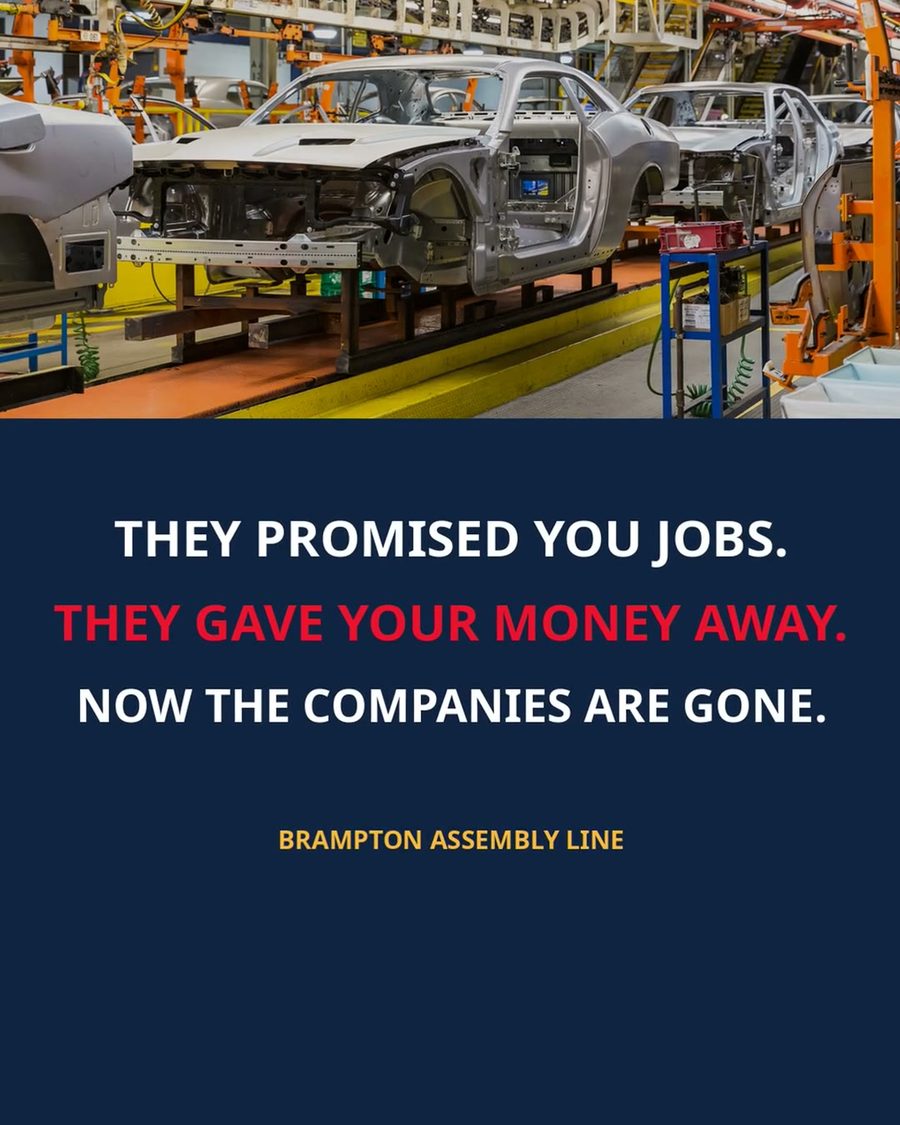
They promised jobs. The companies left with your money. Between 2022 and 2024, Ottawa and the provinces promised roughly $50 billion to car companies to build electric vehicles and batteries in Canada. Four years later, one company is bankrupt, one suspended its project indefinitely, and one sold its plant to a defence contractor. Here is what happened to each dollar.
The $50 billion promise
The number needs explaining before anything else. The Parliamentary Budget Officer put the federal commitments to three battery projects — Volkswagen, Stellantis-LG, and Northvolt — at $43.6 billion. Add Honda's roughly $5 billion, and the total promised to the electric-vehicle push comes to about $50 billion. But most of that money was never paid. The deals were structured as production incentives: the company only collects when it actually makes batteries or cars. A promise is not a cheque — and that distinction is the only thing that saved taxpayers from a much bigger loss.
What was paid is smaller, and it is the part that matters. Quebec put real equity into Northvolt. Ottawa paid real money to Stellantis. Those are the losses you can count. The rest is a lesson in what happens when a government bets public money on an industry's promises.
Northvolt: the bankruptcy
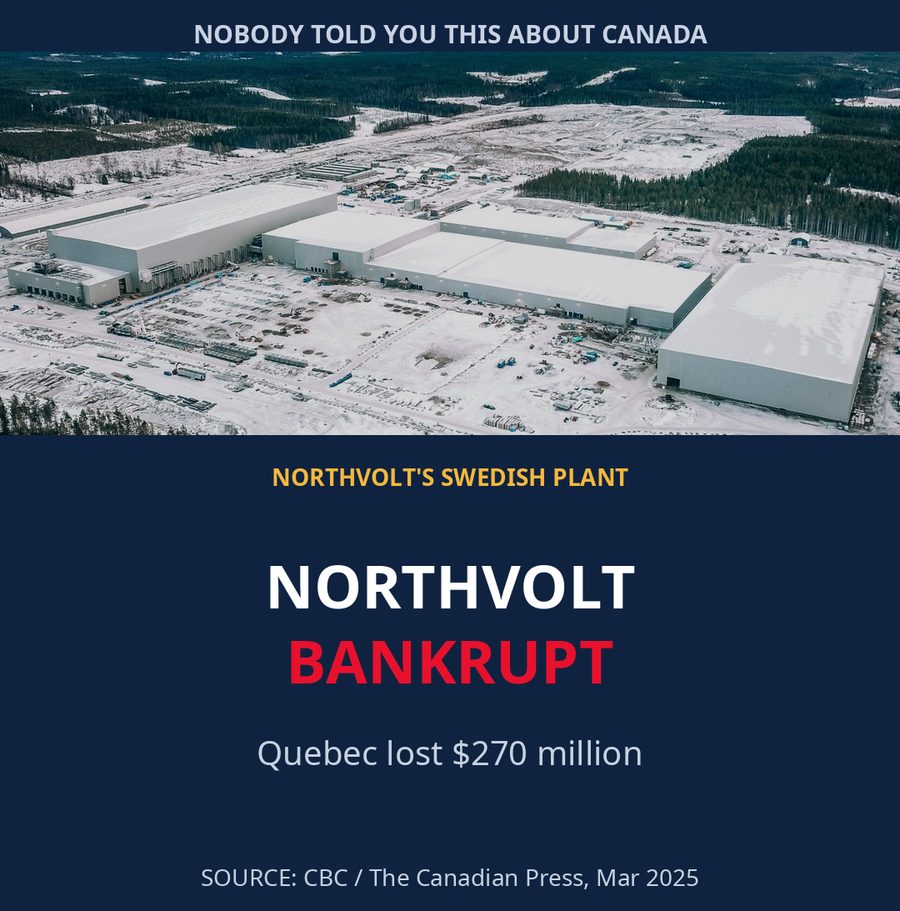
Northvolt was the biggest bet. The Swedish battery maker promised a $7 billion plant in Quebec — Northvolt Six — and 3,000 jobs. Quebec invested $270 million in equity and lent $240 million for the land. The plant never got past site preparation. On March 12, 2025, the Swedish parent company filed for bankruptcy, the largest in modern Swedish history. Quebec's Superior Court declared Northvolt North America insolvent in September 2025.
Quebec lost its $270 million equity outright. The land loan was largely recovered — about $200 million came back from frozen accounts. The Caisse de dépôt, Quebec's pension fund manager, lost $200 million of its own. In November 2026, Hydro-Québec agreed to buy the 172-hectare site, so the land at least stays in public hands. The 3,000 jobs never existed.
Honda: the suspension
Honda's project was the largest single promise: a $15 billion electric-vehicle hub in Alliston, Ontario, building 240,000 electric vehicles a year, creating 1,000 new jobs and protecting 4,200 existing ones. The company paused it in May 2025, citing slowing EV demand. On May 14, 2026, Honda's CEO Toshihiro Mibe suspended it indefinitely.
Here the structure of the deal worked as designed: because the public money was tied to milestones Honda never reached, no public money was paid. The loss is the jobs and the investment that will not come — not cash from the treasury. It is the one case in this story where the taxpayer was protected by the fine print.
Stellantis and Brampton: the betrayal
Brampton is the case that made the news in November 2026, and it is the ugliest. In 2022, the federal government committed up to $529 million toward a $3.6 billion retool of Stellantis's Brampton and Windsor plants. About $220 million had been paid out by early 2025. Production at Brampton stopped in December 2023. The Jeep Compass that was supposed to be built there was moved to Belvidere, Illinois, announced in October 2025.
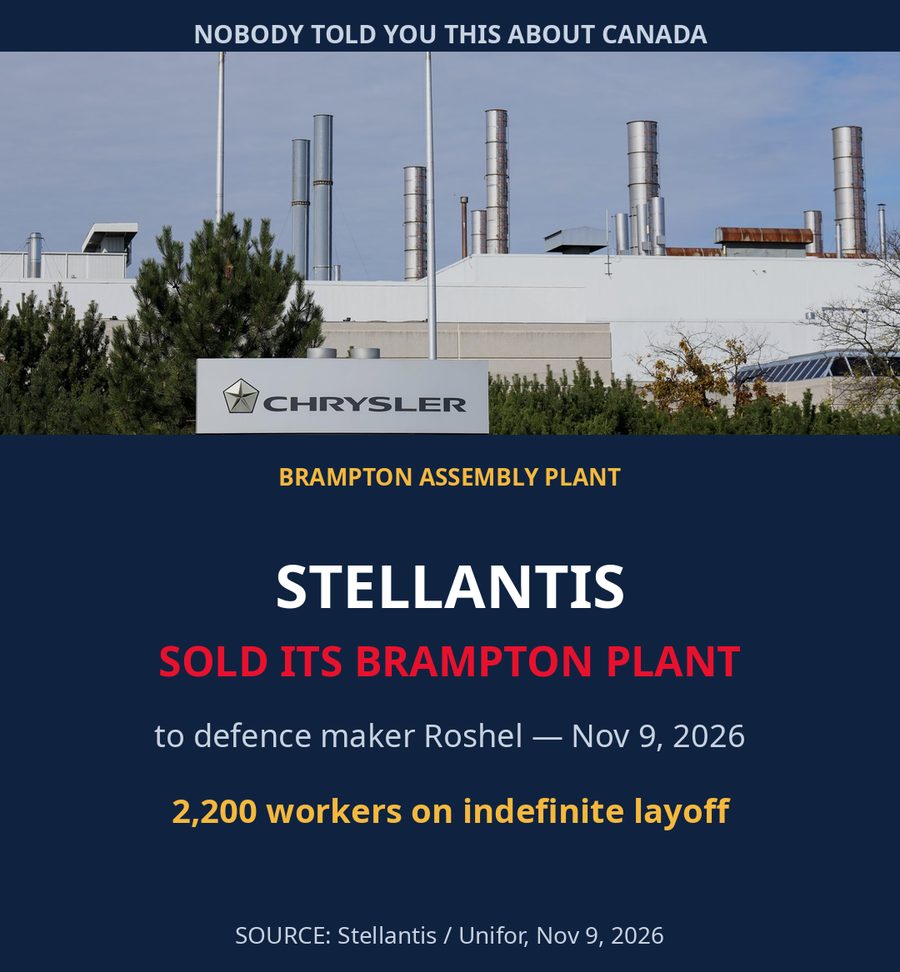
Then, on November 9, 2026, Stellantis sold the Brampton Assembly Plant to Roshel, a defence vehicle maker, for an undisclosed price, with closing expected by the end of the year. More than 2,200 Unifor members have been on paid layoff since December 2023; the plant employed about 3,000 people before it closed. Unifor president Lana Payne called the sale a betrayal — "an underhanded deal." Roshel says 700 to 1,000 of the laid-off workers could eventually return, building armoured vehicles instead of cars.
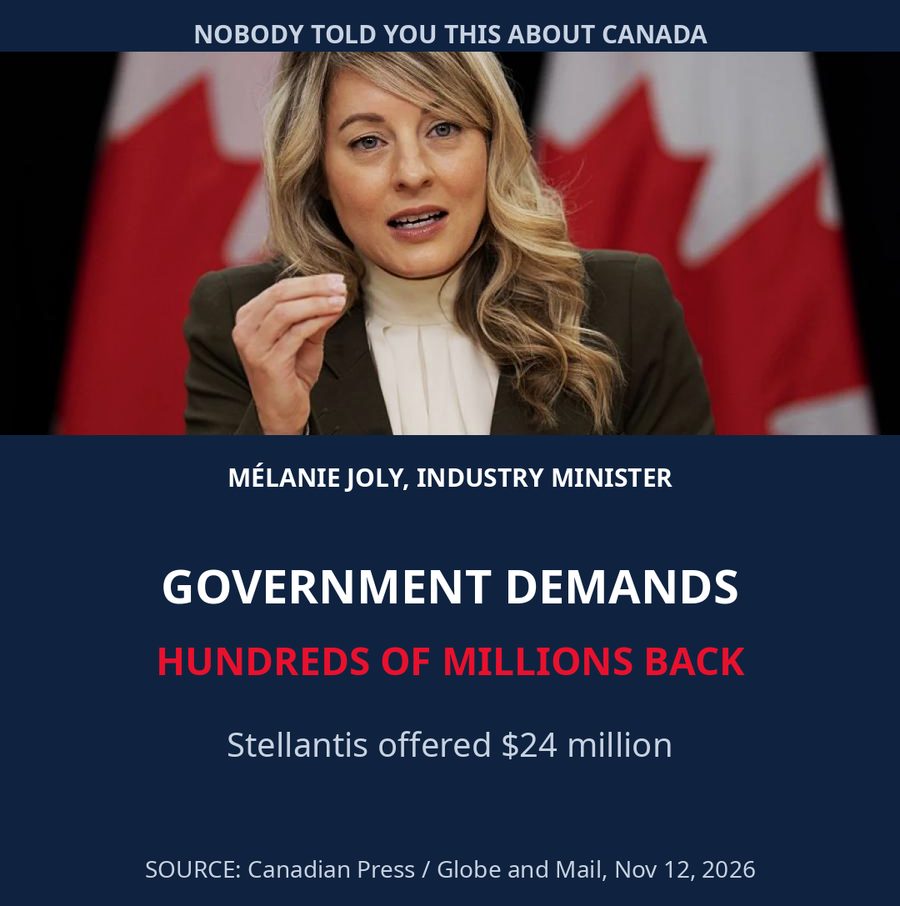
Three days after the sale, on November 12, 2026, Industry Minister Mélanie Joly issued Stellantis a formal notice of default, giving the company 30 days to correct the breach — "or else, of course, we will sue them," she said. The government says Stellantis owes hundreds of millions of dollars under its commitments. Stellantis offered a voluntary repayment of $24 million.
The gap between those two numbers — hundreds of millions claimed, $24 million offered — is the whole story of the EV bet in one line. The government is now in the position of suing a company to recover money it paid for jobs that never came back, while the plant that was supposed to make them builds armoured vehicles instead.
What survived
Fairness requires the other side of the ledger. Not every project failed. NextStar Energy in Windsor — the Stellantis-LG joint venture — has been producing battery modules since 2024 and is ramping up cell production; it is the only project actually making batteries in Canada in 2026. Volkswagen's PowerCo plant in St. Thomas, Ontario, is under construction, though first cells have been pushed from 2027 to 2029, announced in September 2026 — and its up-to-$13.2 billion in production incentives stays unpaid until it produces a single cell.
So the honest scorecard is: one bankruptcy, one indefinite suspension, one plant sold, one factory producing, one under construction and delayed. Against roughly $50 billion promised, the public money actually lost is in the hundreds of millions — real money, but far less than the headline. The bigger loss is harder to count: the jobs that were promised to towns like Brampton and never arrived, and the trust that the next promise will be different.
What it means for you
If you are thinking of moving to Canada, this story is not about cars. It is about how the country spends. A government running a $62.3 billion deficit and carrying roughly $1.31 trillion in federal debt promised $50 billion to an industry and watched most of it fall apart. The jobs were announced with fanfare and quietly cancelled. The workers in Brampton found out from the news.
That is the Canada behind the brochure: a country where the announcement is the easy part. When a politician promises you jobs, a program, or a fast track, ask what has actually been delivered — not what was announced. The difference between the two is where the truth lives.
Sources
- Kurums — Canada's EV battery plants: the full scorecard (PBO $43.6B, Northvolt, Honda, VW, NextStar)
- Morningstar / Dow Jones, Nov 13, 2026 — Stellantis offers $24M; government says hundreds of millions owed
- Collision Repair, Nov 16, 2026 — feds challenge Stellantis over Brampton breach
- Carscoops, Nov 17, 2026 — Canada says Stellantis owes hundreds of millions after the factory sale
- MoparInsiders, Nov 13, 2026 — Unifor challenges the Brampton sale; Payne: "We can't stop the sale. The sale has occurred."
- Budget 2026 — $62.3B deficit, federal debt ~$1.31T