Article
Express Entry: What Nobody Tells You About the New Points
On November 3, 2026, Canada changed Express Entry scoring overnight. A job offer can now be worth 100 points — but only if your occupation is on a list of 186.

Watch the 60-second video version on YouTube →
You checked your Express Entry score last month. On November 3, 2026, Ottawa changed it while you were not looking.
Express Entry is Canada's points system for skilled immigrants. Your age, education, language scores and work history add up to a Comprehensive Ranking System score, and the highest scores get invited to apply for permanent residence. On October 16, 2026, Immigration, Refugees and Citizenship Canada announced a new scoring factor. On November 3, it took effect. Everyone already in the pool is being rescored, and invitation draws are paused while that happens.
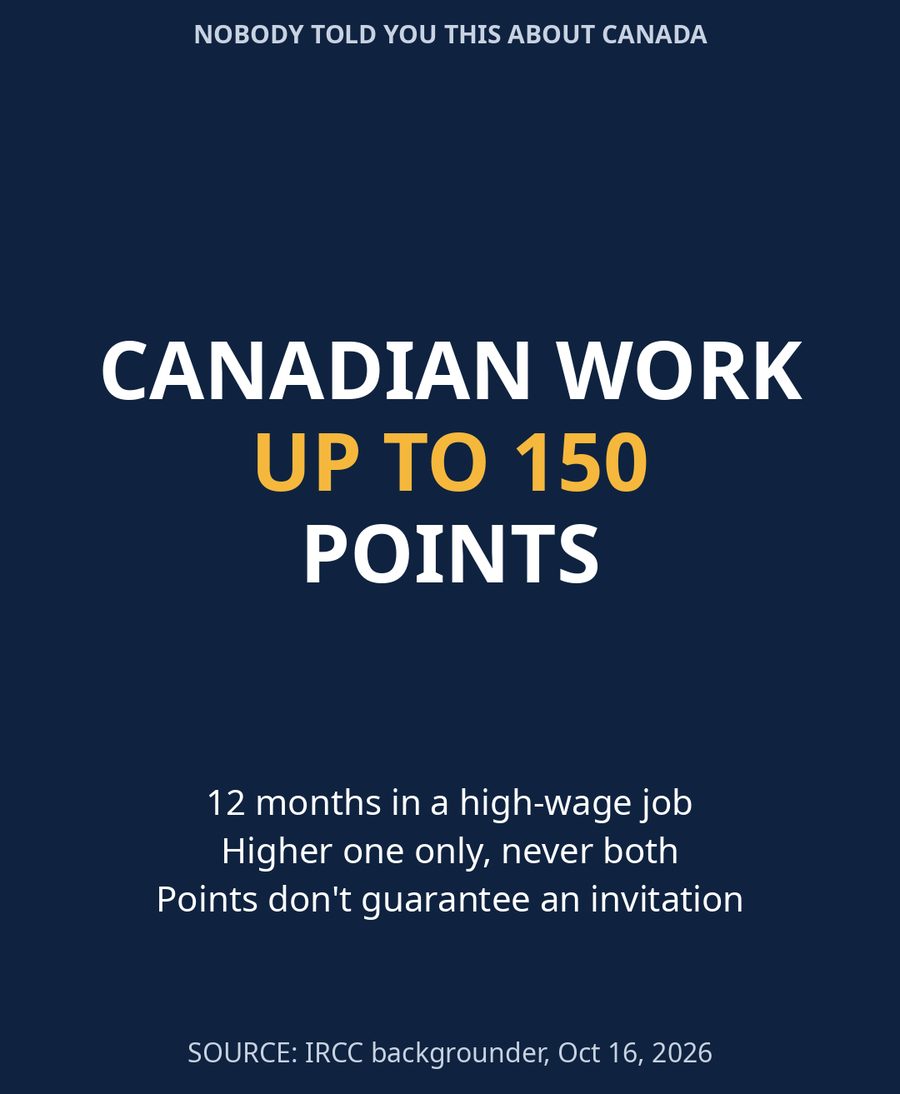
The new factor is called the Labour Market Integration Factor. It rewards two things: Canadian work experience in a high-wage occupation, and a qualifying job offer in one. It can move a score by up to 150 points. It can also move it by zero. Which one depends on a list most candidates have never seen.
What changed on November 3
The announcement came from the Minister of Immigration, Refugees and Citizenship, Lena Metlege Diab, in Kitchener, Ontario, on October 16, 2026. The change took effect on November 3. From that date, candidates in the Express Entry pool are scored on a new factor with two routes — and they receive the higher of the two, never both added together.
The first route is a qualifying job offer in a high-wage occupation. Depending on the occupation's wage tier, it is worth 50, 70 or 100 points. The second route is Canadian work experience: at least 12 months working in Canada in a high-wage occupation earns a bonus of 20, 40 or 70 points on top of the existing points for the length of that work experience, up to a combined maximum of 150 points for a candidate without an accompanying spouse or partner, or 140 with one.
One more change arrived the same day: a Labour Market Impact Assessment, an LMIA, is no longer required for a qualifying job offer to receive these points. IRCC still checks that the offer is genuine. But the employer's long LMIA process is no longer the gate it was.

150 points is the cap, not a bonus
This is the part most headlines get wrong. The 150 points is the total cap for the whole factor — not 150 extra points on top of everything else you already had. The work-experience route combines your existing points for the length of your Canadian work (up to 80 points for five years) with the new high-wage bonus (up to 70). Together they cap at 150. If you already had 80 work-experience points, the new money is at most 70.
The same rule applies between the two routes. If your job offer is worth 100 points and your Canadian work experience is worth 120 under the factor, you get 120 — not 220. IRCC compares the two routes and awards the higher one. And more points do not guarantee an invitation. Draws still depend on the cut-off score in each round, and nobody knows what the new cut-offs will be until draws restart.
The catch: it is not your salary
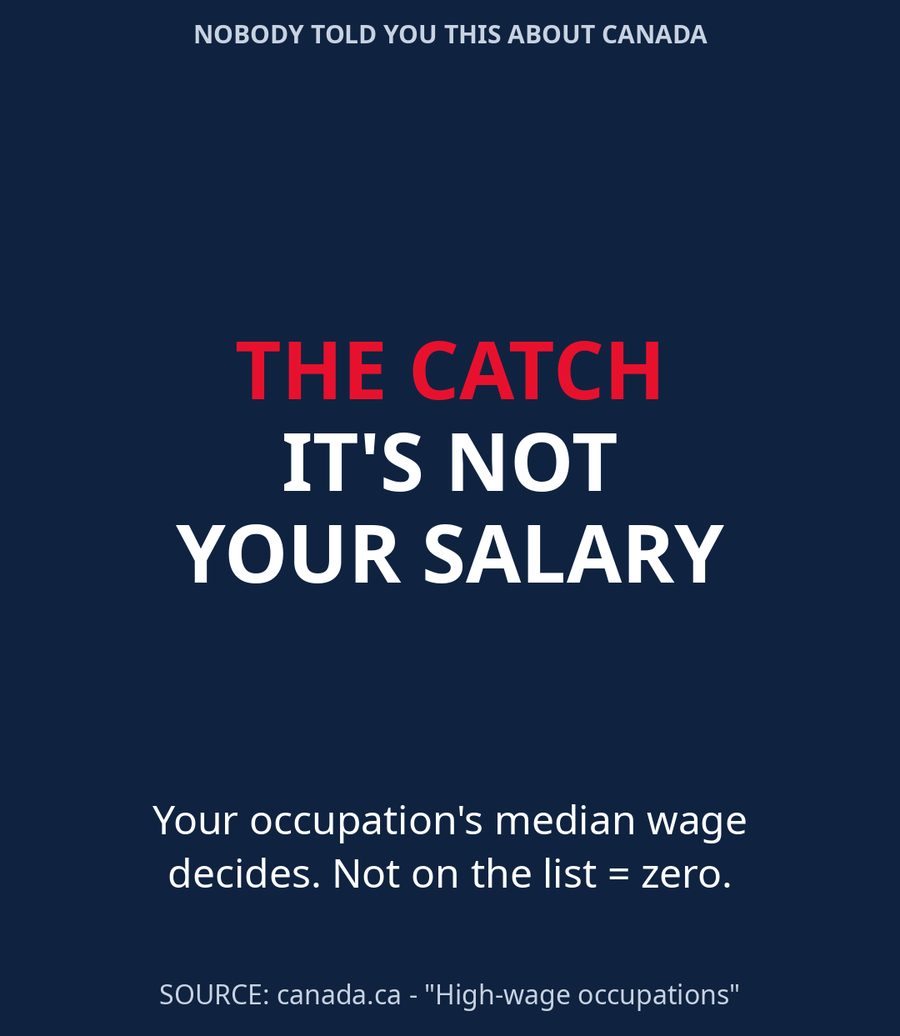
Here is the catch, and it is the whole story. Whether your job counts as high-wage has nothing to do with what you personally earn. IRCC looks at the median wage of everyone in Canada working in your occupation — your NOC code — and compares it with the average median wage of the whole Canadian workforce. If your occupation's median is at least 1.3 times that average, the occupation is on the list. If it is not, your salary does not matter. A high salary in a job that is not on the list earns zero points.
The list holds 186 occupations, in three tiers: 31 at twice the median wage or more, 89 at 1.5 times, and 66 at 1.3 times. The tiers decide the points. A job offer in a top-tier occupation is worth 100 points; in the middle tier, 70; in the lowest tier, 50. The work-experience bonus follows the same tiers: 70, 40 or 20 points.
The list is built from Job Bank, Labour Force Survey and census data from 2023 to 2025. It is specific to the occupation code, not the job title. Two jobs that sound the same can sit on different sides of the line. The check that matters is your NOC code against the published list — not your pay slip, not your job title, not what your employer calls the role.
Your salary does not decide your points. Your occupation's median wage does. A high salary in a job not on the list earns zero.
Who gains, who gains nothing
The winners are clear: people already working in Canada in a listed occupation, and people with a genuine job offer in one. For them, the new factor can be the difference between waiting in the pool and getting an invitation.
Everyone else gains nothing. If you are still outside Canada, with no Canadian work experience and no job offer, your score has not moved. The change does not touch your age, education or language points. About 228,000 profiles were in the pool as of October 25, 2026, and all of them are being rescored — but for candidates with no Canadian work and no offer, the rescoring changes nothing.
Draws are paused — and nobody has named a restart date
IRCC said the recalculation could take up to two weeks from November 3, and invitation rounds are paused while it runs. As of November 17, 2026, the latest draw is still round 453, held on October 28. No restart date has been published. Candidates who wanted job-offer points were told to update their profiles before November 3; that deadline has passed, and the article makes no promise about late updates.
That pause is the honest reason to wait before celebrating a new score. Until draws restart and the first new cut-off scores appear, nobody knows what a score is worth under the new system. A candidate who gained 70 points may still sit below the cut-off. A candidate who gained nothing may find the cut-off moved toward them — or away.
What to do now
Check your occupation first
Find your NOC code and check it against IRCC's published high-wage occupations list on canada.ca. If your occupation is on the list, check which tier it sits in — that decides your points. If you are already in the pool, check your recalculated score once IRCC finishes the rescoring. If you have a job offer, confirm it is full-time, continuous work in Canada for at least one year after you become a permanent resident — that is what a qualifying offer means.
And keep the warning in mind: extra points are not an invitation, and a list is not a promise. The occupations on it were chosen from 2023–2025 wage data. Wage data moves. Lists get revised. The candidates who do well under this system are the ones who check the list themselves, at the source, before they make a plan around it.
Sources
- IRCC news release, Oct 16, 2026 — Canada refocusing Express Entry on top talent that drives economic growth
- IRCC backgrounder, Oct 16, 2026 — Changes to Express Entry for high-wage occupations
- IRCC — High-wage occupations and how we assess them (canada.ca)
- Zagdim — Express Entry's 3 November Points Change — tier counts, 150-point cap explained
- Leak Release — Canada Express Entry 2026 — latest draw round 453 (Oct 28), draws paused as of Nov 17, 2026