Article
Four Landlords Caught on Camera
Radio-Canada's Enquete filmed Quebec's real-estate influencers at work: rent hikes of 51% and 76%, tenants pressured to sign. Here is what happened — and what happened next.

On October 22, 2026, Radio-Canada's Enquête broadcast "Influenceurs immobiliers: des portes à tout prix" — real-estate influencers, doors at any price. Hidden cameras filmed four Quebec landlords and investors pushing rents up by 51 and 76 per cent and telling tenants to sign on the spot.
The country that built things
Canada was a country that built things. In 1921, Banting and Best discovered insulin at the University of Toronto; the first patient, 14-year-old Leonard Thompson, was treated in January 1922, Banting won the Nobel Prize in 1923, and the team sold the patent to the university for $1. In 1958, Canada flew the Avro Arrow, a jet interceptor ahead of its time — cancelled on February 20, 1959, "Black Friday", when 14,000 people lost their jobs overnight and the prototypes were cut up for scrap. The Canadarm went into space in 1981 and flew 90 shuttle missions. In 1956, Lester Pearson invented UN peacekeeping and won the Nobel Peace Prize in 1957.
Then the country changed: the fastest way to get rich in Canada today is not to build something, but to buy someone else's home and raise the rent. Enquête showed how: buy cheap older buildings with low rents, push rents up 30 to 50 per cent or more, refinance, repeat. Every extra dollar of monthly rent adds about $180 to a building's value. The report's conclusion: "these techniques, while legal, have a negative impact on the majority of tenants."
Cory Albert: 25 years old, 200 doors
Cory Albert was 25 when the report aired. He is from Gatineau and bought his first building at 19, with his mother's help. He says he owns 200+ apartments, a portfolio he values at $35 million, and claims to earn $20,000+ a month — his claims, not verified figures. He has about 120,000 TikTok followers and sells a course, "How to Buy Your First Profitable Triplex", for $3,500. Radio-Canada paid $3,500 to enrol.
In Saint-Georges-de-Beauce, Albert planned to buy 29 apartments in four buildings for about $3 million. The average rent was $625 a month. His plan: raise it to $1,100 — up 76 per cent — and move heating from gas to electricity, paid by the tenants. He set aside $130,000 to buy tenants out, $5,000 each. The tenants included a person on $840 a month in welfare. A $1,100 rent on an $840 income is not a business plan. It is an eviction by arithmetic.
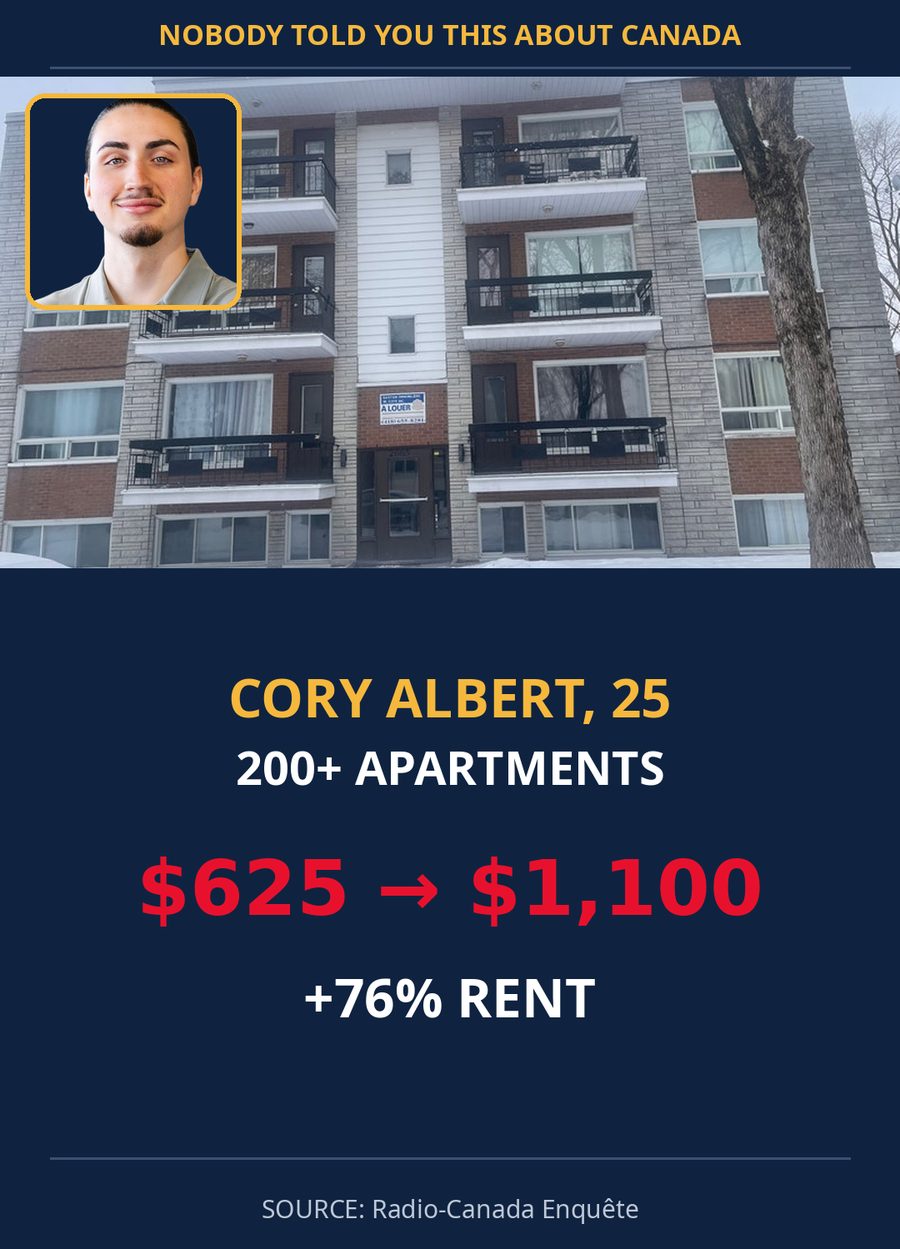
After the broadcast, Albert backed down: "I have decided not to increase tenants' rent in the medium term." The seller, Atlas Société Immobilière, cancelled the sale on October 27, 2026. Albert told Enquête by email: "I always insist that proposals be made voluntarily. Coercion is not a solution." The viral quote about raising a rent "from $500 to $1,500" came from an unnamed participant in Albert's training, not from Albert. And the Pigeon Street building in this story is not his — it belongs to the fourth landlord below.
Gabrielle Borgia: "I don't care if the building is garbage"
Gabrielle Borgia is a real estate broker in Laval, licensed since October 2016, and owner of 50 rental units. On camera, she said what the others only implied: "I buy buildings where people will get themselves out on their own. I target people in financial difficulty and mental precarity." Then: "I don't care if the building is garbage and I don't care if the people are garbage." Her advice: raise rents at least 30 per cent, ideally about 50 per cent. "You want tenant turnover, so you're not going to pamper them." Maintenance? "Maintenance menus, cosmetic repairs. Are you going to do them? Never."
Borgia refused an interview. By phone she said: "I always respect ethical rules, and my mandate is given by the client." Her broker's permit has been suspended since October 22, 2026, the day of the broadcast; the registry gives the reason as "Administrative". That matters: an administrative suspension is not a disciplinary sanction, and the regulator, the OACIQ, has not publicly linked the suspension to the report. Radio-Canada's follow-up video asserts the link. The regulator has not.
Jocelyn Grégoire: nearly 1,000 units
Jocelyn Grégoire is about 50 and has been investing since 2011. He owns nearly 1,000 housing units, per a 2026 Quebec Court of Appeal decision. He founded Les Mordus d'immobilier, an investor community, and a private lender, CEDMA Finance, and wrote a book called De bum à millionnaire.
On hidden camera, Grégoire described shutting off the heat two or three times in October, so tenants would complain — then installing electric heating at the tenants' expense. His response to Enquête: "The statements do not accurately represent the facts as they actually occurred." He later said he received death threats.
In May 2025, Quebec's financial markets tribunal, the TMF, found that he and Cedma had acted illegally as a mortgage broker and securities dealer, and imposed penalties totalling $210,000, plus a three-year director/officer ban. But on September 3, 2026, the Court of Quebec confirmed the $80,000 penalty and annulled the $130,000 portion. The video says he "already paid $210,000". The courts say otherwise: $80,000 stands, $130,000 does not.
Sébastien Gagnon: the one who said sorry
Sébastien Gagnon, the fourth person in the report, is not an influencer. He is a developer: president of Cité Immobilier in Victoriaville and co-founder of Spypoint. In August 2025, he bought 36 apartments in six buildings on Pigeon Street for less than $4 million — about $104,000 per door. The tenants were mostly elderly, averaging about 72. Some had lived there for 50 years. The previous owner had raised rents by only $5 to $15 a year.
Gagnon demanded new leases at $1,050 a month for everyone — an average increase of 51 per cent, about $351 a month. One tenant, Thérèse, faced a rise from $658 to $1,050, up 52 per cent. Tenants were pressured to sign on the spot; 25 of the 36 signed. If rents rose by half, the buildings would be worth $1.5 million more. One tenant said she had considered suicide. Mireille, 81, left for a smaller, more expensive place; her old apartment was relisted in August 2026 at $1,295 a month, up 89 per cent.
And then Gagnon did something the other three did not do. In the spring of 2026, he reversed nearly all of the Pigeon Street increases and apologized. "Our approach of proposing new leases signed by mutual agreement was clumsy," he said, while denying that he had pressured tenants. He met the tenants to "rebuild trust". Thérèse took her case to the housing tribunal — and Gagnon backed down, gave up the 52 per cent increase, and reinstated her old lease. There was no judgment, because there was nothing left to judge.
That is the part of the story that matters most. A man who had the power to take more chose, in the end, to give it back.
A man who had the power to take more chose, in the end, to give it back.
The tribunals are drowning
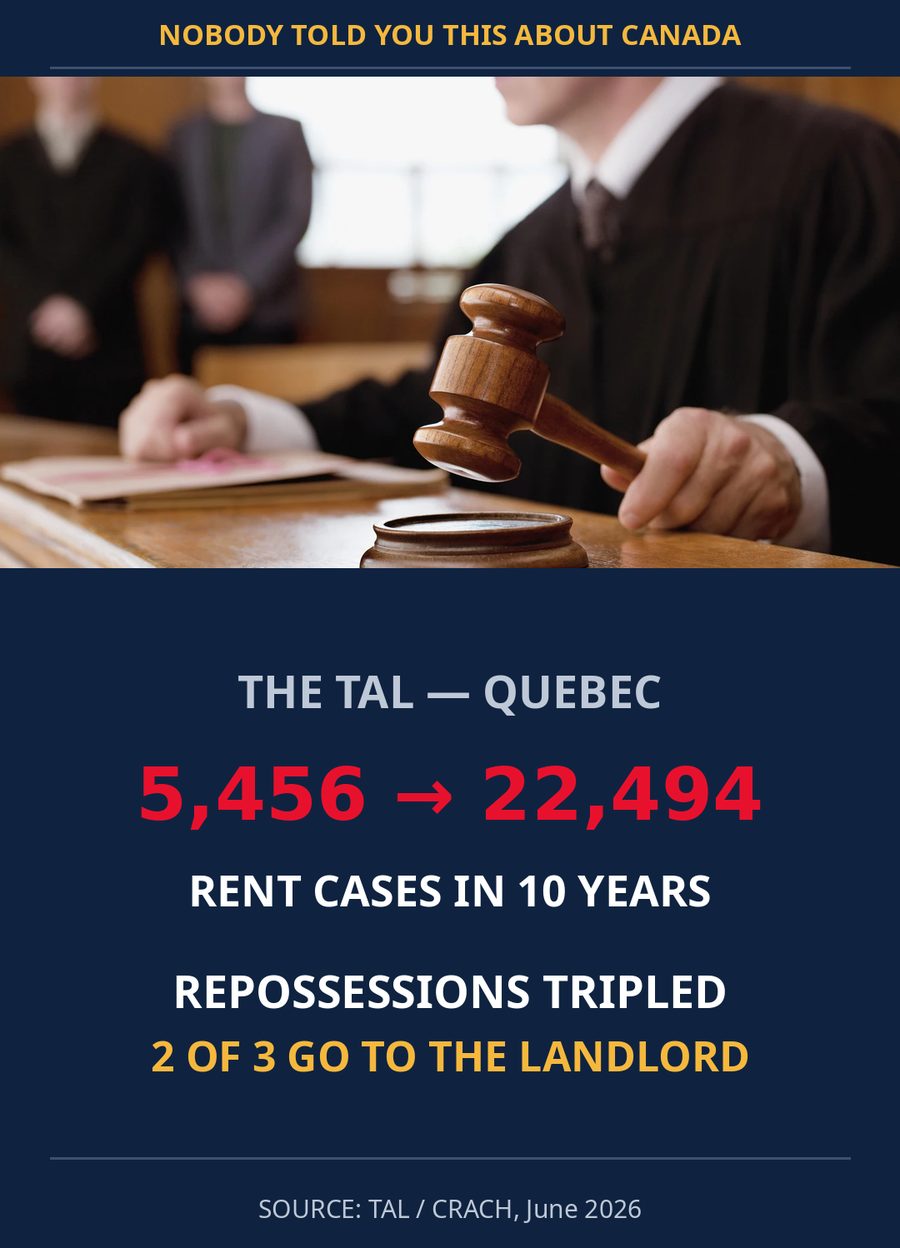
According to a June 2026 study by CRACH, a Quebec housing research group, using the tribunal's own dashboard, rent-fixing cases at Quebec's Tribunal administratif du logement (TAL) rose from 5,456 in 2015-16 to 22,494 in 2024-25 — more than four times as many in ten years. Repossession cases roughly tripled, from 898 in 2013-14 to 3,126 in 2024-25, and about two in three are decided for the landlord. Unpaid-rent applications hit a record 42,934 in 2024-25. For scale: the TAL's 2026 rent benchmark is 3.1 per cent. The increases in the Enquête report — 51 and 76 per cent — were 15 to 25 times that benchmark.
Ontario is the same story. The Landlord and Tenant Board received 45,435 applications to evict for non-payment of rent in 2024-25, up from 37,690 two years earlier — about 20 per cent more. And on September 21, 2026, Ontario cut the eviction notice for unpaid rent from 14 days to 7. A tenant raising other issues at the hearing — a broken heater, a leaking roof — must now pay half the arrears first.
People are leaving
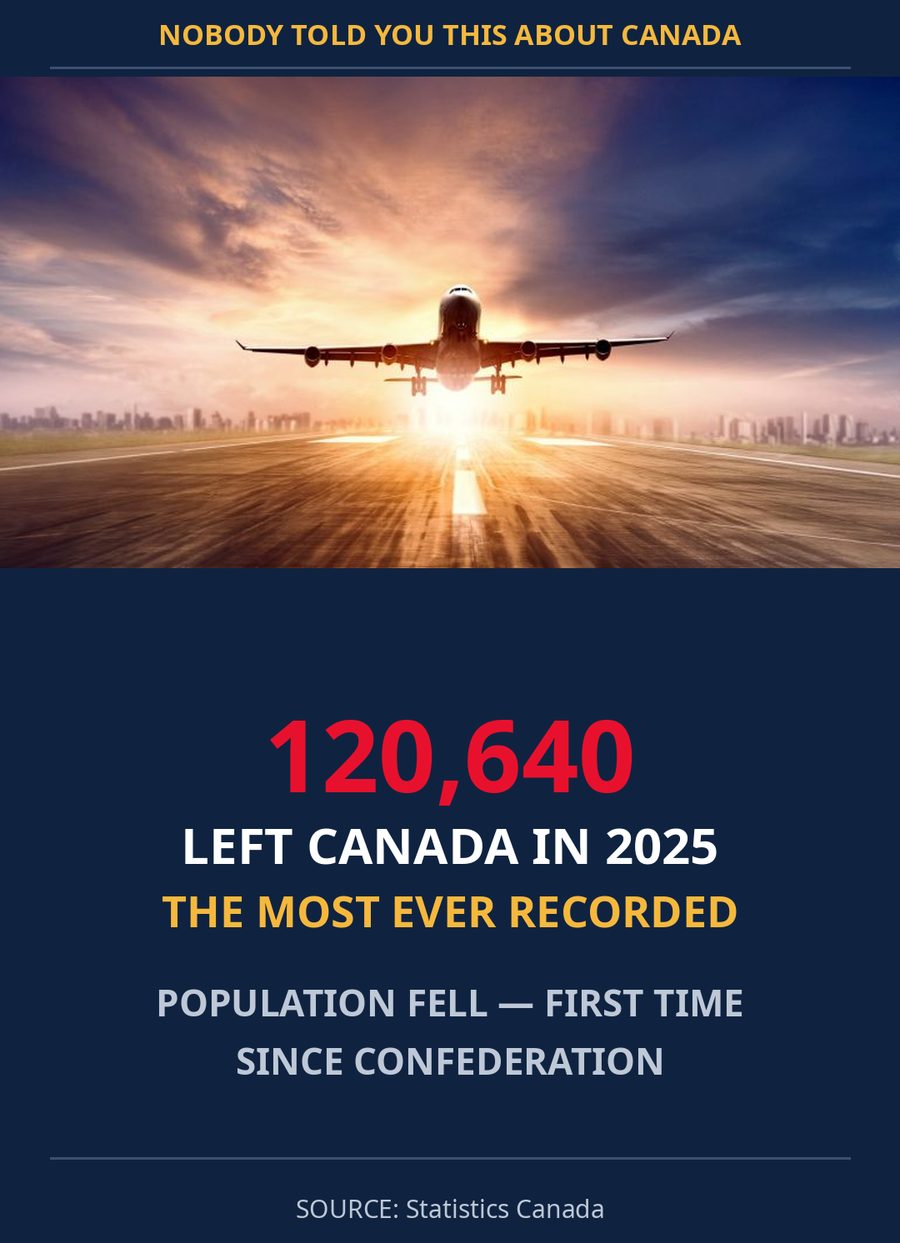
In 2025, 120,640 citizens and permanent residents left Canada for good — the most ever recorded, in records back to 1952. Net emigration, after subtracting those who came back, was 65,706, also a record. The population fell by just over 102,000, the first annual decline since Confederation in 1867.
Honesty requires the other half. The rise over 2024 (118,409 departures) was only 1.9 per cent, and the emigration rate barely moved — 0.287 to 0.290 per cent of the population. Most of the population drop came from temporary residents leaving as permits expired: about 958,000 departures in 2025. The exodus is real, but smaller than the headline suggests. What is not small is the reason people give: the cost of living.
On a single night in 2025, 65,083 people across 75 Canadian communities had nowhere to sleep. Toronto's average asking rent was $2,593 a month in October 2026. About 6.5 million Canadians have no family doctor. Unemployment hit 6.7 per cent in October 2026, 13.7 per cent for ages 15 to 24. And 29.7 per cent of Canadians lived in a household reporting difficulty meeting basic financial needs. A Québec solidaire petition against the landlords' practices passed 33,000 signatures within two weeks of the broadcast.
The cost of living
Canada is the 21st most expensive country in the world for groceries (Numbeo Groceries Index, 2026). Striploin beef reached $42.42 a kilogram in April 2026. Food banks recorded nearly 2.2 million visits in March 2025 — the highest ever, double 2019. About one in five food bank clients has a job.
Meanwhile, since December 2023, federally regulated workplaces must provide free menstrual products in every washroom, including men's rooms. Budget 2026 added $70 million over two years for the Menstrual Equity Fund. In the video, Remus calls Prime Minister Carney a dictator. That is his verdict, not a finding of any court or inquiry.
The richest country in the world
Canada's natural resource wealth was worth $1.36 trillion in 2024, according to Statistics Canada. It holds about 170 billion barrels of proven oil reserves, third-largest in the world, and produces about 5.5 million barrels a day, the fourth-largest producer. It is the world's second-largest uranium producer, with the highest-grade deposits on earth. It is the fourth-largest gold producer — and holds zero official gold reserves, the only G7 country with none. Canada once held 1,023 tonnes of gold, in 1965; the last was sold in 2016. The United States holds more than 8,100 tonnes.
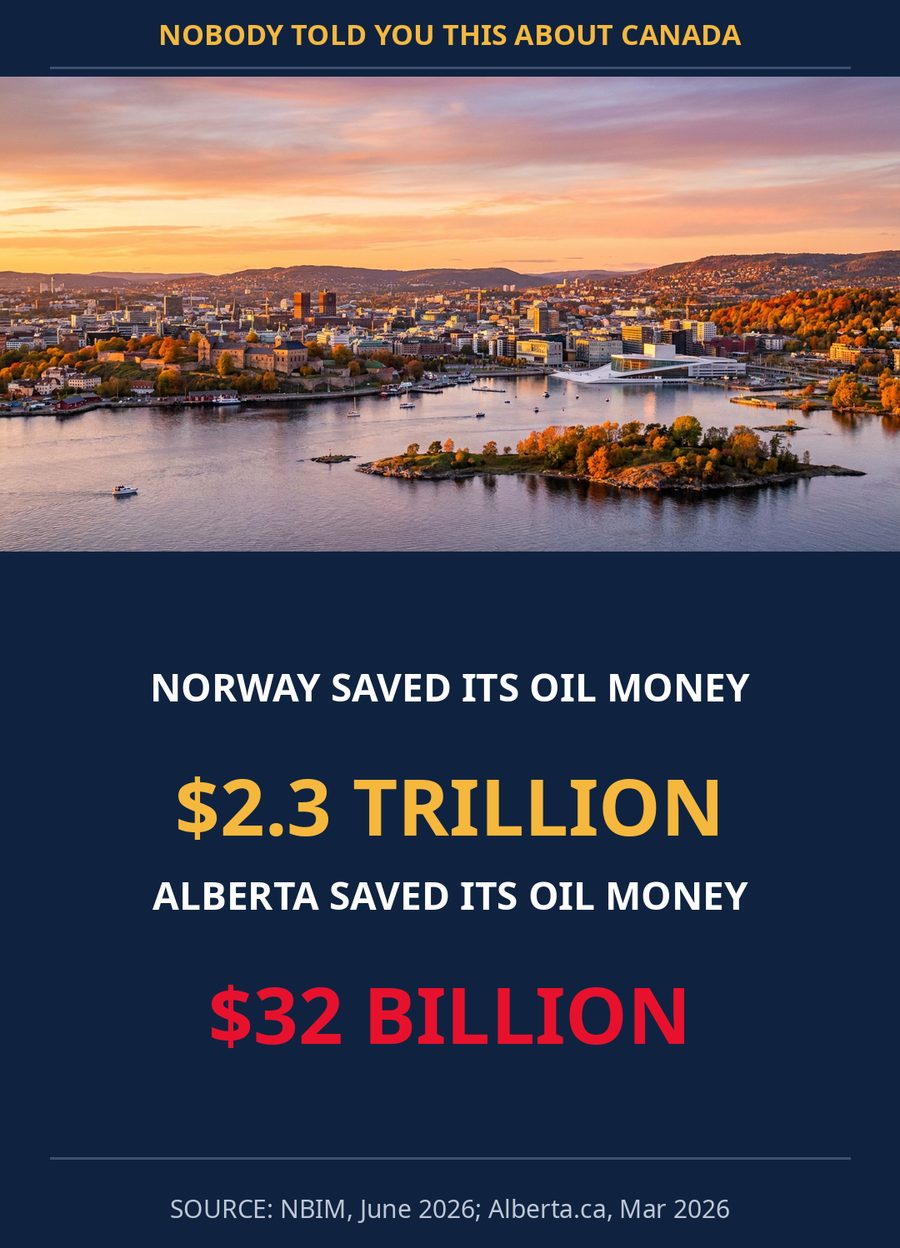
Norway has about 7 billion barrels of proven oil — roughly one-twentieth of Canada's. Norway saved its oil money in a fund now worth about US$2.3 trillion, roughly $390,000 for every Norwegian. Alberta created its Heritage Savings Trust Fund in 1976, twenty years before Norway's, and stopped putting money into it in 1987. It is worth C$32 billion. Remus's verdict is that the resources are being stolen — sold off while ordinary Canadians get poorer. That is his conclusion.
If your landlord tries this
In Quebec, you can refuse a rent increase in writing within one month — the landlord must then apply to the housing tribunal, and the tribunal decides. The tribunal's 2026 benchmark is 3.1 per cent. Never sign a new lease on the spot. If you are pressured, ask for the proposal in writing and take it to a tenants' association or legal aid clinic before you sign.
Sources
- Radio-Canada, Enquête — Influenceurs immobiliers: des portes à tout prix, Oct 22, 2026 (the four landlords)
- Radio-Canada — Influenceurs immobiliers en Beauce (written report)
- McGill University — The first Canadian Nobel Prize (insulin, 1921-1923)
- Legion Magazine — Broken Arrow (Avro Arrow, first flight 1958, cancelled 1959)
- Canadian Space Agency — About Canadarm (first deployed Nov 13, 1981; 90 missions)
- NobelPrize.org — Lester B. Pearson, Nobel Peace Prize 1957 (Suez, UNEF)
- CQPI — Preventing homelessness in Québec (42,934 unpaid-rent filings, 2024-25)
- Tribunals Ontario 2024-25 Annual Report, via ProptxVerify — LTB caseload (45,435 L1 applications)
- Statistics Canada, Table 17-10-0040-01 — Emigration, 2025 (120,640 emigrants, record)
- Open Data Canada — Are Canadians leaving in record numbers? The 2025 math (context on the emigration rate)
- Housing, Infrastructure and Communities Canada — Everyone Counts 2025 (65,083 people on one night)
- Rentals.ca / Urbanation, National Rent Report, October 2026 — Toronto average asking rent $2,593
- Statistics Canada, Labour Force Survey, October 2026 — Unemployment 6.7%, youth 13.7%
- Numbeo Groceries Index 2026, via Expatica — Canada 21st most expensive for groceries
- Food Banks Canada — HungerCount 2025 (2.2 million visits in March 2025)
- Budget 2026, Annex 4, via WomanACT — $70 million over two years, Menstrual Equity Fund
- Natural Resources Canada — Generation Energy (170 billion barrels, third-largest reserves)
- Alberta Heritage Savings Trust Fund — C$32 billion; Norway fund US$2.29 trillion, June 2026