Article
Rent and Homelessness in Canada: 1990 to Today
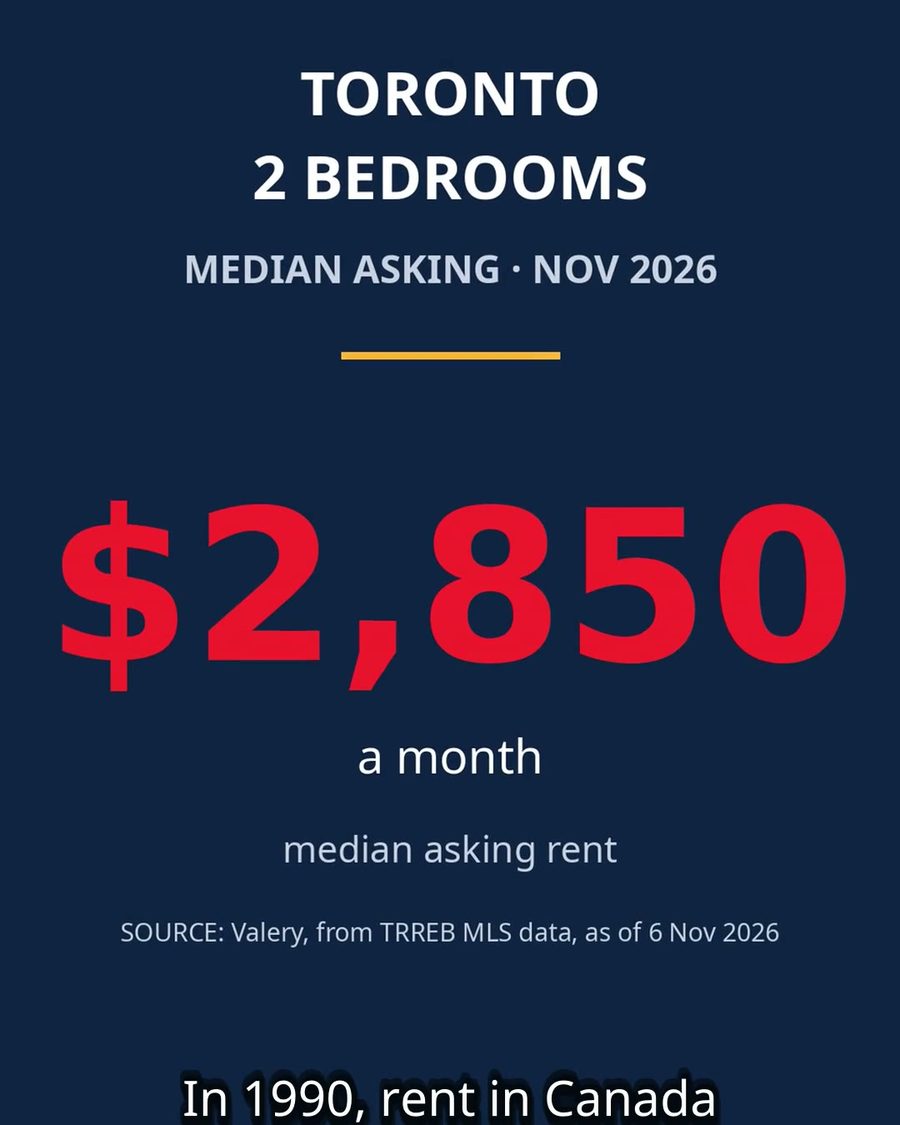
In 1990, average rent in Canada was $504 a month. Today a two-bedroom in Toronto asks $2,850 — and on one night in 2025, over 65,000 people had nowhere to sleep.
Watch the 60-second video version on YouTube →
In 1990, rent in Canada was $504 a month. Today, a two-bedroom in Toronto asks $2,850.
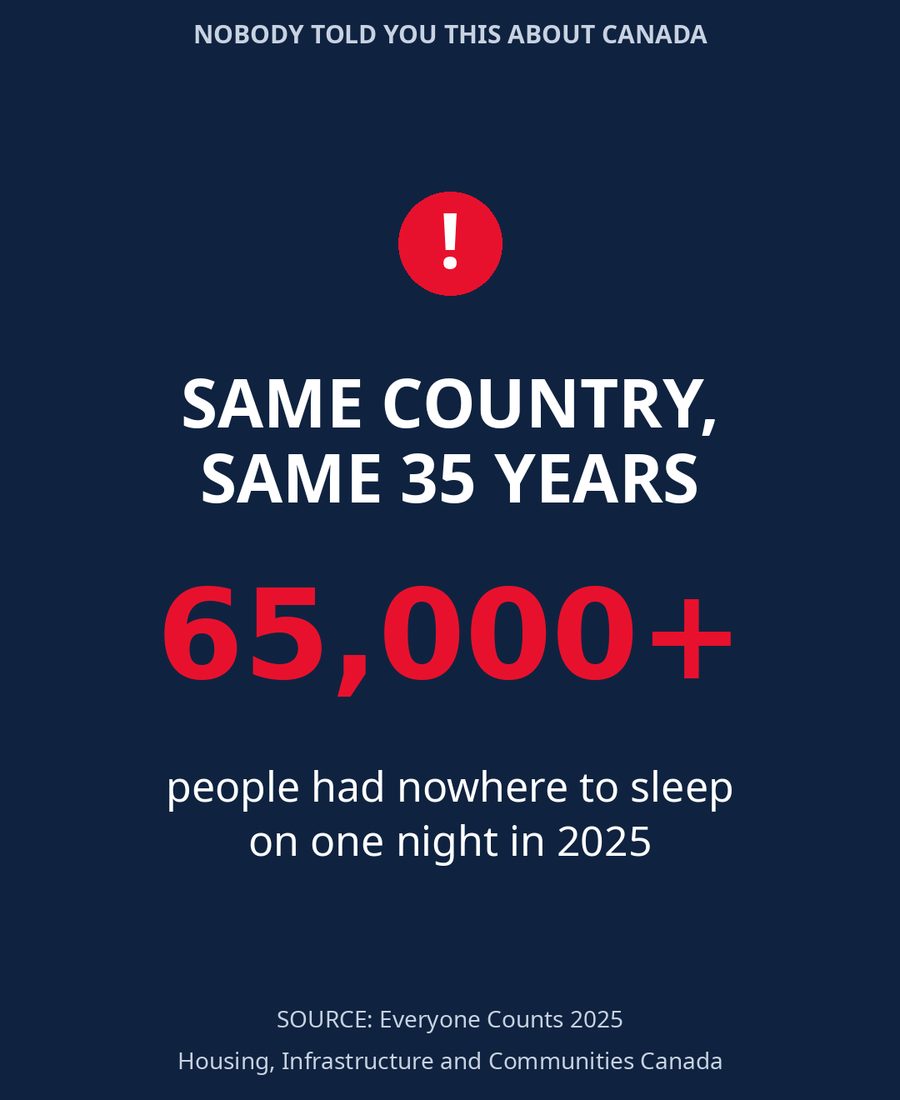
Same country. Same thirty-five years. And on one night in 2025, more than 65,000 people had nowhere to sleep. If you are packing a bag for Canada, this is the number to know before you land — not after.
Rent is the first bill every newcomer meets, and it is the one that decides whether the rest of the plan works. A job that pays well on paper can still leave you choosing between rent and food. A city that looked affordable from abroad can eat half your paycheque before the month starts. The numbers below are not opinions. They are the official counts, and they all point the same way.
The rent line never went down
Canada Mortgage and Housing Corporation has measured what tenants actually pay every October since 1990. The average rent across Canada was $504 a month in October 1990. By October 2025 it was $1,488. That is nearly three times as much — and the line never fell once in thirty-five years. Not in a recession, not in a pandemic, not in any year at all.
What tenants pay is one number. What landlords ask a new tenant is another, and it is higher. In October 2026, the average asking rent across Canada was $2,036 a month, according to Rentals.ca and Urbanation. Asking rents have now fallen year over year for 25 months straight — the national figure is down 3.2 percent from a year ago — but "falling" needs context: it is falling from a record high, and in Toronto it has already turned back up.
Toronto's average asking rent was $2,593 a month in October 2026 across all property types: $2,229 for a one-bedroom, $2,965 for a two-bedroom on average. The median asking rent for a Toronto two-bedroom — the middle listing, not the average — was $2,850 as of November 6, 2026, from Valery's reading of Toronto Regional Real Estate Board MLS data across 2,711 listings. Vancouver asks more: $2,754 on average. Montreal asks $1,950, Calgary $1,870, Winnipeg $1,653. City choice is the single biggest lever a newcomer has, and it is decided before the flight, not after.
Can you afford it?
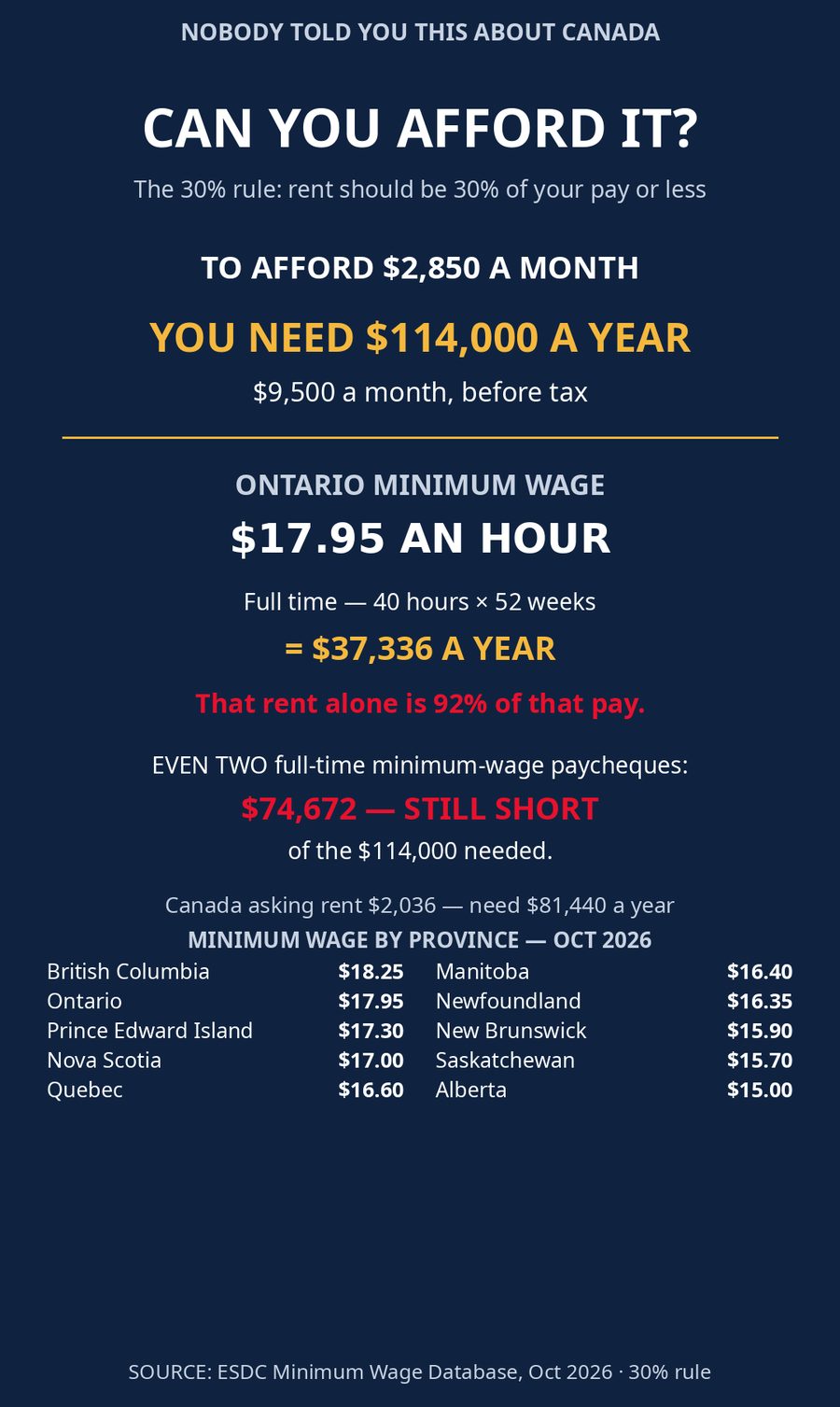
The standard rule is that rent should be 30 percent of your pay or less. Run the numbers on a $2,850 Toronto two-bedroom and the rule asks for $114,000 a year before tax — $9,500 a month. Ontario's minimum wage is $17.95 an hour. Full time, 40 hours a week, 52 weeks a year, that is $37,336 a year. That rent alone is 92 percent of that pay. Even two full-time minimum-wage paycheques — $74,672 — fall short of the $114,000 needed.
The national picture is less extreme but not kind. The Canada-wide average asking rent of $2,036 needs $81,440 a year under the same rule. And the vacancy rate — the share of rental homes sitting empty — was 3.1 percent nationally in October 2025. A healthy market runs closer to 5 percent. At 3.1 percent, landlords choose among applicants, and newcomers without Canadian references or credit history choose last.
The buying power is gone
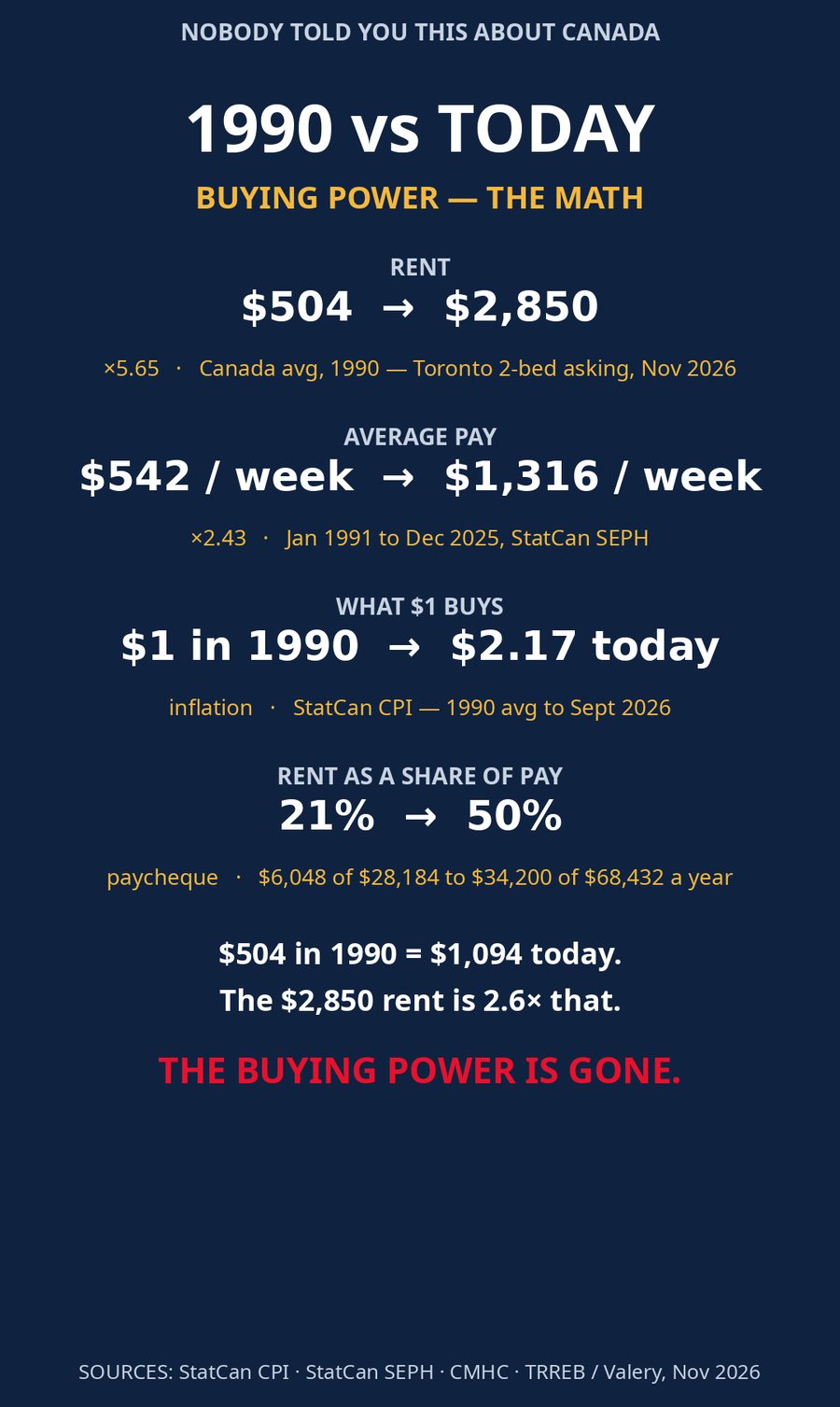
It is not only that rent rose. It is that rent rose much faster than pay. Average weekly earnings went from $542 in January 1991 to $1,316 in December 2025 — up 2.43 times. Rent went from $504 to $2,850 — up 5.65 times. Pay more than doubled. Rent more than quintupled.
Inflation alone does not explain it. One dollar in 1990 buys what $2.17 buys today. So $504 of 1990 rent, adjusted for inflation, would be $1,094 today. The $2,850 Toronto two-bedroom is 2.6 times that. In 1990, rent took about a fifth of an average paycheque — 21 percent. Today it takes half — 50 percent. That is what "the buying power is gone" means in numbers: the same work buys half the home it used to.
65,000 people, one night
Seven prime ministers have governed Canada since 1990 — Mulroney, Campbell, Chrétien, Martin, Harper, Trudeau, Carney. The rent line went up under all of them. And at the far end of that line is the number that should stop any newcomer mid-plan.
On a single night in 2025, the federal Everyone Counts enumeration found more than 65,000 people experiencing homelessness across 75 communities — 65,083 people counted, the report's headline figure rounded to 65,000. That is 59 percent higher than in 2020–22. More than half were in shelters (36,716 people, 56 percent). More than a quarter were unsheltered — outside, in encampments, in places not meant for sleeping (17,620 people, 27 percent). The rest were in transitional housing (10,747, 17 percent). The share living unsheltered has grown from 23 percent to 27 percent in five years.
One honest note: the total was roughly stable against the previous count in 2023–24, down 2.6 percent in the communities that could be compared. The crisis stopped getting worse last year. It did not get better. It is stuck at a record high.
And one thing this article will not do is invent a 1990 homelessness number. Canada did not count homelessness nationally in 1990. The first national count came in 2016. Anyone who gives you a 1990 figure is guessing. The rent line can be drawn back to 1990. The homelessness line cannot — and saying so is part of telling the truth.
In 1990, rent was a fifth of a paycheque. Today, half. The buying power is gone.
Check the rent yourself
Do not take anyone's word for it — including this article's. Before you choose a city, open the listing sites and look at the prices yourself: Rentals.ca, Zumper, Kijiji, PadMapper, liv.rent, Realtor.ca. Search the city you plan to live in, the size you need, and the budget you actually have. Then do the 30-percent maths on the pay you will really earn in your first year, not the pay you hope to earn in your fifth.
Know your rights before you pay a deposit
Deposit rules change by province. In Ontario, a landlord can only ask for last month's rent — no security deposit. In Quebec, no security deposit is allowed at all, only the first rent period at signing. Never pay a deposit to hold a unit you have not seen: the standard rental scam is a copied listing pressuring you to send money before a viewing, and an Interac e-Transfer cannot be reversed once it is accepted. If a landlord demands more than the province allows, that is a warning, not a negotiation.
Canada is still a country where a newcomer can build a life. But the life is built on rent first, and rent is the number that breaks the most plans. Know it before you land. Check it yourself. And choose the city with the maths, not the postcard.
Sources
- CMHC — Historical Rental Market Statistics, Canada — average rent $504 (1990) to $1,488 (Oct 2025), vacancy 3.1%
- Rentals.ca / Urbanation — National Rent Report, Nov 5, 2026 (Oct 2026 data) — Canada $2,036, Toronto $2,593
- Valery, from TRREB MLS data — Toronto 2-bed median asking rent $2,850, as of Nov 6, 2026 (2,711 listings)
- Housing, Infrastructure and Communities Canada — Everyone Counts 2025 — 65,000+ on one night, up 59%
- Europe Says / Canadian Housing Survey analysis — where people slept: shelters 56%, outdoor 20%, encampments 7%, transitional 17%