Article
Study in Canada Does Not Mean You Can Stay in Canada
A study permit is not a path to permanent residence. Three locks decide your work permit — and the rules move while you are studying.
Watch the 60-second video version on YouTube →
Study, then work, then stay. It sounds like a promise. Nothing in writing promised it.
Every year, thousands of students arrive in Canada believing the path is simple: study for two years, get a work permit, get permanent residence. The study permit is only the first step, and it guarantees nothing after it. What decides whether you can stay and work is a separate document — the Post-Graduation Work Permit, or PGWP — with its own rules, its own locks, and its own ways of saying no.
The PGWP is an open work permit: it lets you work for any employer in Canada after you graduate. It lasts 8 months to 3 years depending on your program, and you only ever get one. You must apply within 180 days of finishing. Miss that window, or fail one of the locks below, and the path you paid for closes.
Lock 1: Your school is not enough — your program must be eligible
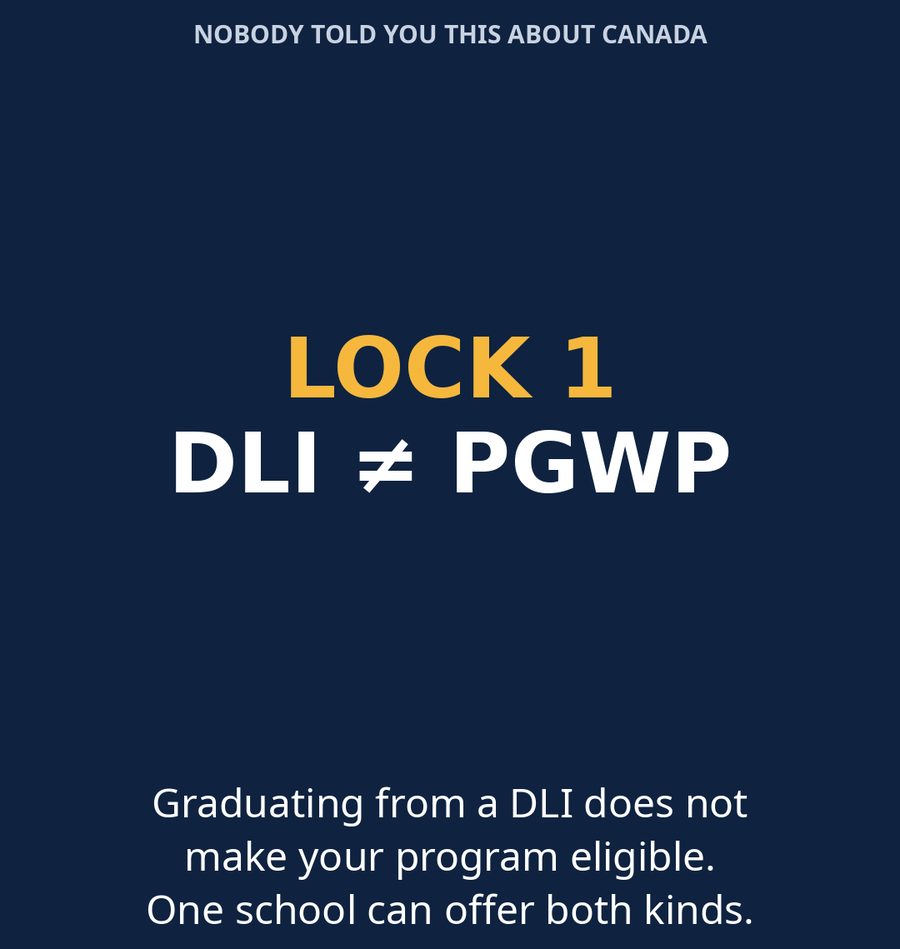
Your school must be a Designated Learning Institution, a DLI. That is the easy part, and it is where most people stop checking. Graduating from a DLI does not make your program eligible. One school can offer both eligible and ineligible programs, and the difference is not written on the brochure.
IRCC keeps a list of designated learning institutions with a PGWP-eligible tab. That tab is the check that matters. Your exact program must be on it — not just your school.
Non-credit programs do not qualify. Programs delivered by a private college on behalf of a public college — curriculum licensing agreements, also called public-private partnerships — are not PGWP-eligible in most cases if you started after May 15, 2024. A program can look real, cost real money, and still leave you with no work permit.
Lock 2: Eight months, full-time, half in person
Your program must run full-time for at least eight months — 900 instructional hours for eligible vocational programs in Quebec. You must keep full-time status in every semester, except that you may study part-time in your final semester.
Then comes the part people miss. If your lock-in date is on or after September 1, 2024, at least half of your program must be completed in class, inside Canada. Time spent studying outside Canada is deducted from the length of your work permit. Complete more than half of your program through distance learning and you are not eligible at all. Online study from outside Canada after August 31, 2024 does not count toward your permit length. The classroom rule is not a detail. For students who started online from home, it can cut months off the permit — or remove it entirely.
Lock 3: For non-degree programs, your field must be on the list
This is the lock that fails the most people, because it is the newest and least visible. Since November 1, 2024, graduates of non-degree programs — college diplomas, certificates, post-graduate certificates — must show their field is on IRCC's list of occupations in long-term shortage. The list runs on six-digit CIP codes. Your program has one. Either it is on the list or it is not.
Bachelor's, master's and doctoral graduates are exempt from this lock. Everyone else who applied for a study permit on or after November 1, 2024 is not. The eligible list holds 1,107 CIP codes, and IRCC froze it for 2026 — no fields added or removed during the year. A freeze is not a promise for 2027. The list has changed before, and it will change again.
The language test nobody warned you about
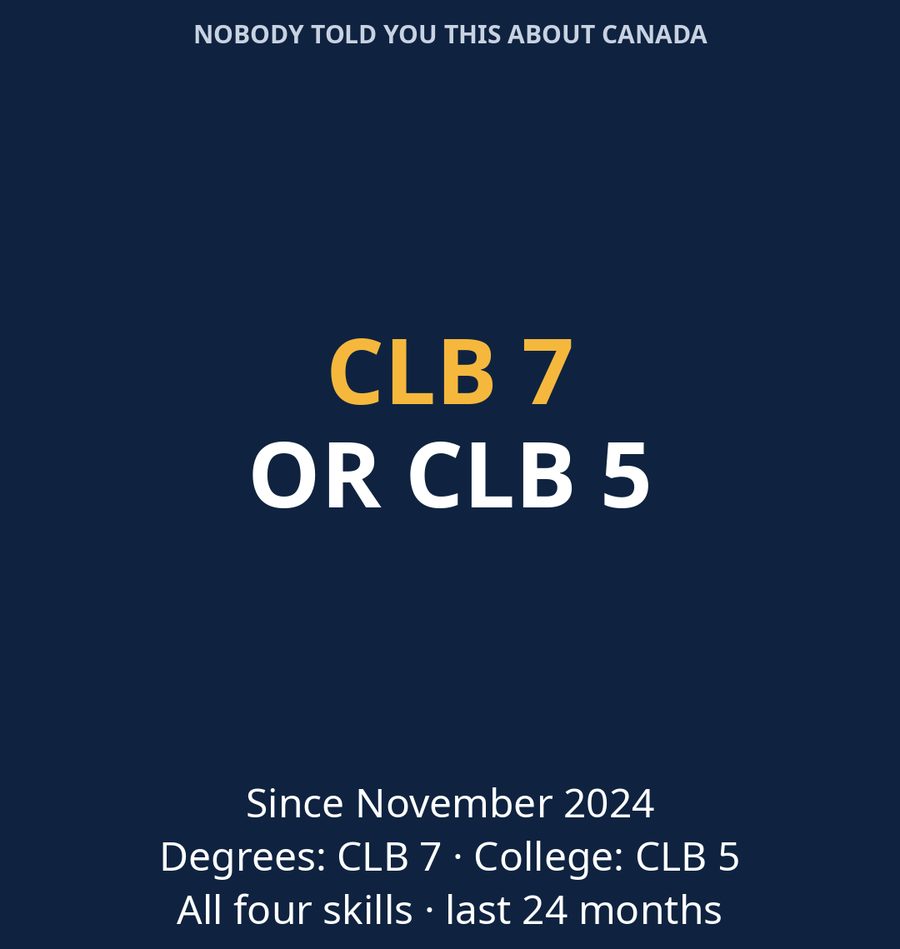
Since November 2024, most PGWP applicants must also prove language ability. The level depends on what you graduated from: CLB 7 in English (or NCLC 7 in French) in all four skills for bachelor's, master's, doctoral and other university graduates, and CLB 5 for college, polytechnic and other non-university graduates. The test must be less than two years old when you apply. All four skills means all four — reading, writing, listening, speaking. A strong score in three and a weak one in the fourth is a fail.
What it costs to find out the hard way
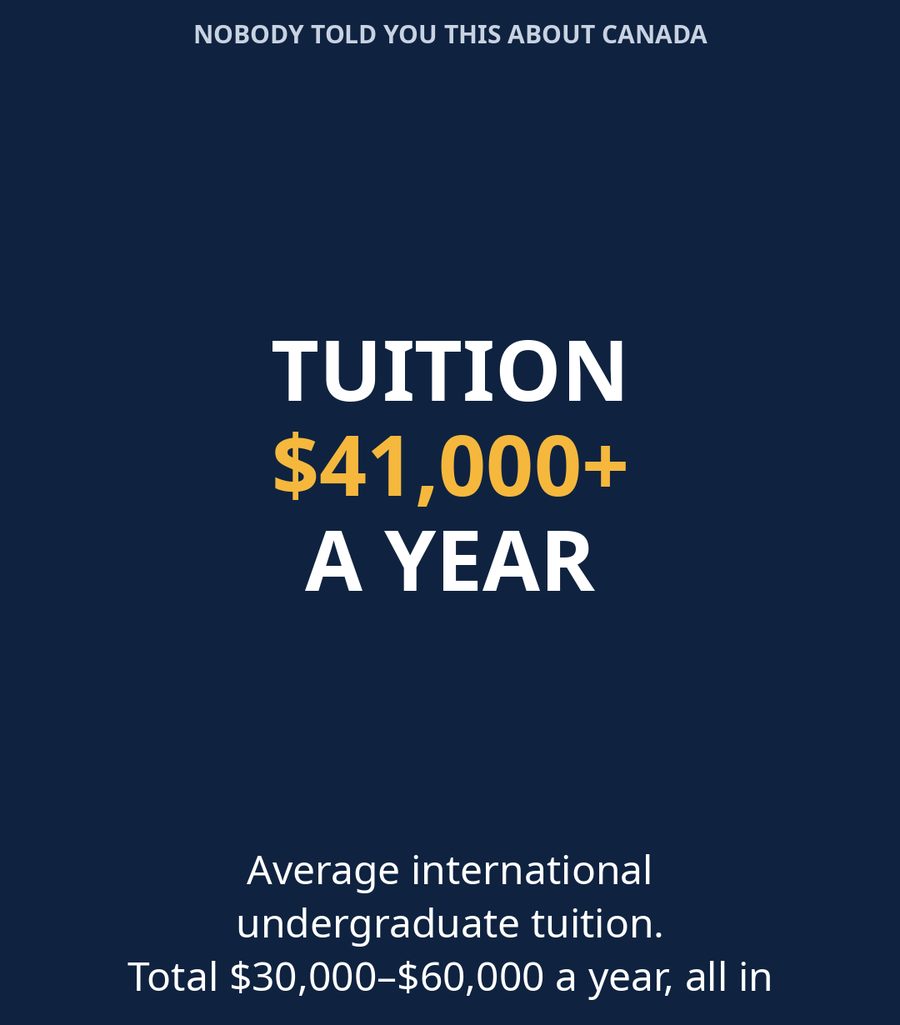
The money at stake is large. Average international undergraduate tuition in 2026/27 is $42,062 a year, according to Statistics Canada — up 4.0% in one year, and more than five times the $8,021 a Canadian undergraduate pays. Ontario averages $50,088; Newfoundland and Labrador averages $18,911. Province choice alone can cut your tuition by more than half.
Before you even arrive, IRCC asks a single applicant outside Quebec to show $23,448 in living funds for the year, for applications from September 1, 2026 — on top of first-year tuition and travel. A full year, all in, runs roughly $30,000 to $60,000 depending on the program and the city. That is a broad range, not one official figure — two students in two provinces can pay very different amounts for the same two years.
That warning already happened in Calgary. In July 2026, graduates there started receiving PGWP refusal letters. They had studied through continuing-education partner sites connected to Portage College, a public college in Alberta — programs in business management, teacher assistance, and administration, delivered at sites in Calgary and Edmonton. About 480 graduates of those partner-delivered programs were refused; community organizers estimated that up to 1,500 graduates in Calgary were affected. Some students took their cases to Federal Court. Others went on hunger strike.
The refusals cited one word: non-credit. IRCC had updated its PGWP eligibility page on June 24, 2026 to state plainly that non-credit programs do not qualify. IRCC says nothing changed — only the website was updated, to clarify a requirement that always existed. The students say they enrolled years earlier believing their programs were eligible. Both sides are on the record, and the dispute is not settled.
The rules move while you are studying. The check you do before you pay is worth more than any promise after you arrive.
What is settled is the lesson. A program's eligibility is decided by IRCC's list and IRCC's rules, not by what a recruiter told you, not by what a college email said in 2024, and not by how much tuition you already paid. The students in Calgary did everything they were told to do. The refusals came anyway.
How to check before you pay
Do this before you pay a deposit
Check the school on IRCC's Designated Learning Institutions list — on the PGWP-eligible tab, not just the main list. Ask the school's international student office, in writing, whether your exact program is PGWP-eligible, and ask for its six-digit CIP code. Check that code against IRCC's eligible field-of-study list yourself. Ask whether the program is credit-bearing, and whether it is delivered at the school itself or through a partner site. Keep every email. If the school will not answer in writing, that is your answer.
Then check the rest: the program is at least eight months, full-time, with at least half in class in Canada. Book your language test early enough that the result is still under two years old when you apply. And re-check everything at canada.ca before you apply — IRCC writes these rules, and IRCC rewrites them. A study permit is a chance to study in Canada. It was never a promise that you could stay.
Sources
- IRCC — Post-graduation work permit: who can apply (canada.ca) — all PGWP eligibility rules
- immigrate.io — Post-graduation work permit guide (rules checked Nov 1, 2026 against IRCC) — 1,107 CIP codes, language levels, 180-day window
- Settle Canada — Why International Tuition Keeps Rising in Canada (2026) — Statistics Canada 2026/27 tuition averages
- Gofar Global — Canadian University Tuition, International Students 2026-27 — provincial tuition averages
- Immigration News Canada — Canada's PGWP Refusals Leave Hundreds Of Graduates In Limbo — Calgary July 2026 refusals, IRCC June 24 update
- Creebhills — College or University? What International Students Get Wrong — Portage College case, 1,500 estimate