Article
The Agent Who Sold You Canada
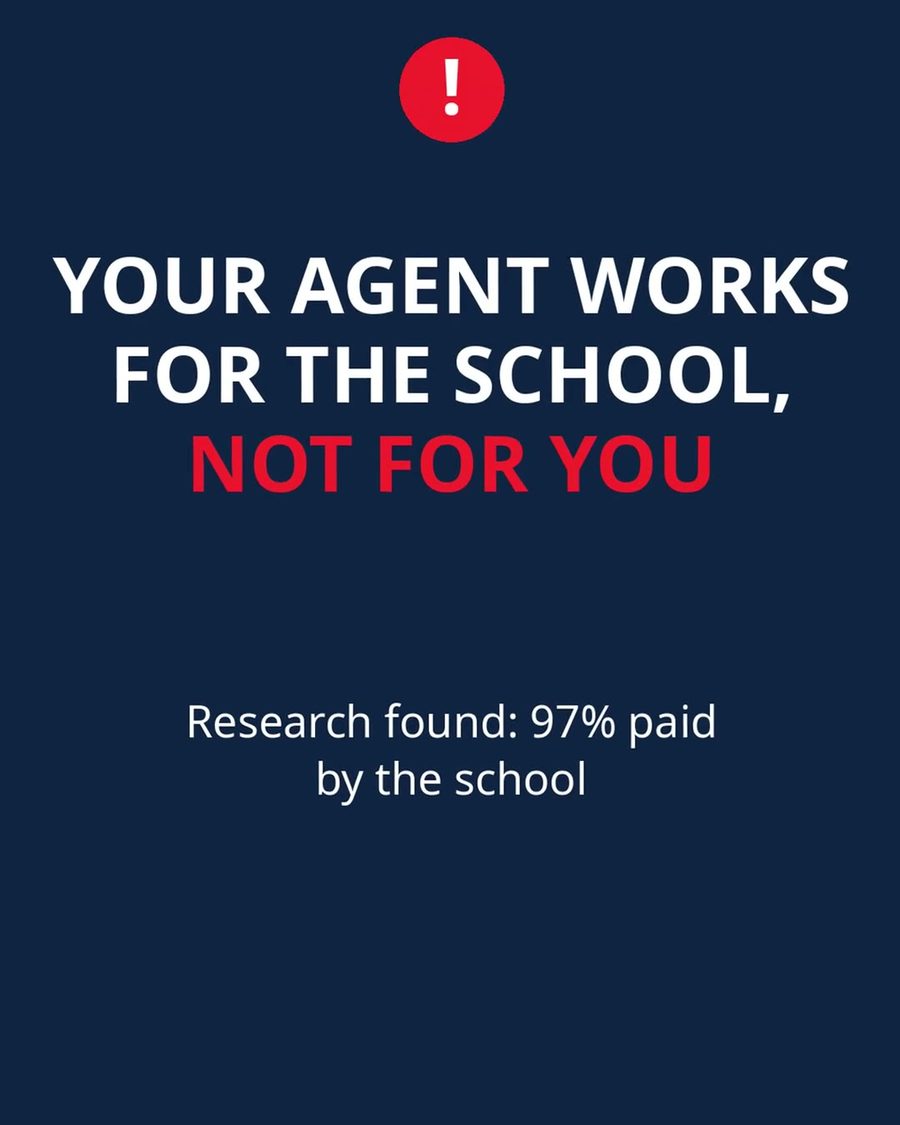
Your agent told you they work for you. In 97% of cases, research found, the school pays them — and the school that pays the most is not always the school that fits you.
Watch the 60-second video version on YouTube →
Your agent told you they work for you. Research found that in 97 percent of cases, the school pays them.
Somewhere between your home town and a Canadian campus, someone sold you Canada. Maybe it was a friendly office with flags on the wall. Maybe it was a voice on the phone who already knew which college was "perfect for you" before you had finished your sentence. The advice felt free. It was not free. Somebody paid for it — and it was not you.
This is how the business works, and once you see it, you cannot unsee it. The person advising you on the biggest decision of your young life is usually paid by the school you end up attending. That does not make every agent dishonest. It makes the advice something you should check, not something you should trust blind.
Who pays the agent
Nearly all education agents — 97 percent, according to research from the British Universities International Liaison Association and Universities UK International — are paid by the institution, usually a commission triggered when a referred student enrols. That is UK research, not a Canada-only number, but the model is the same in Canada: the school pays, the student is the product being delivered.
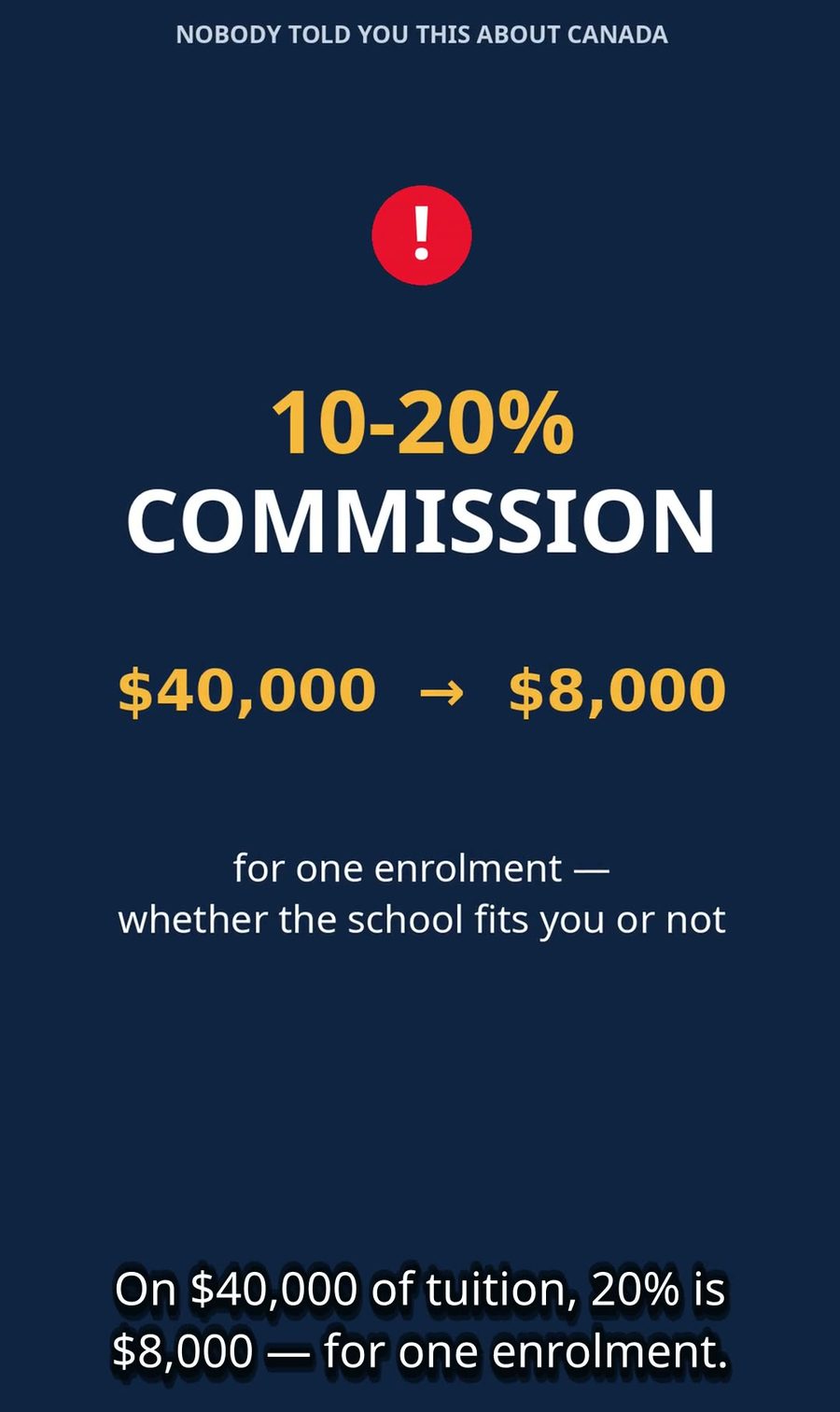
A typical commission is 10 to 20 percent of the student's first-year tuition, sometimes a flat fee instead. On $40,000 of first-year tuition, a 20 percent commission is $8,000 — for one enrolment, whether the school fits you or not. The more expensive the program, the bigger the payment. That is the incentive, sitting in plain sight: an agent earns more by steering you to the most expensive program that will take you, not the one that fits your goals, your budget, or your chance of a work permit after graduation.
The schools know exactly what they are buying. In 2019, CBC obtained records showing Cape Breton University — where international students had come to make up more than half the student body — spent $1.1 million on recruitment agents in a single year, more than double the year before. Its vice-president of finance called the arrangement a $7 million revenue lift. The students were the revenue. The agents were the sales force.
Some agents go further and charge both sides: a fee from the student for "counselling" and a commission from the school for the enrolment. The industry calls this double-dipping. It is common enough that a national commission studying the practice could not agree on whether to call it unethical. If your agent charges you a fee, ask them in writing whether they also receive a commission from the school — and how much.
The legal line most people never hear
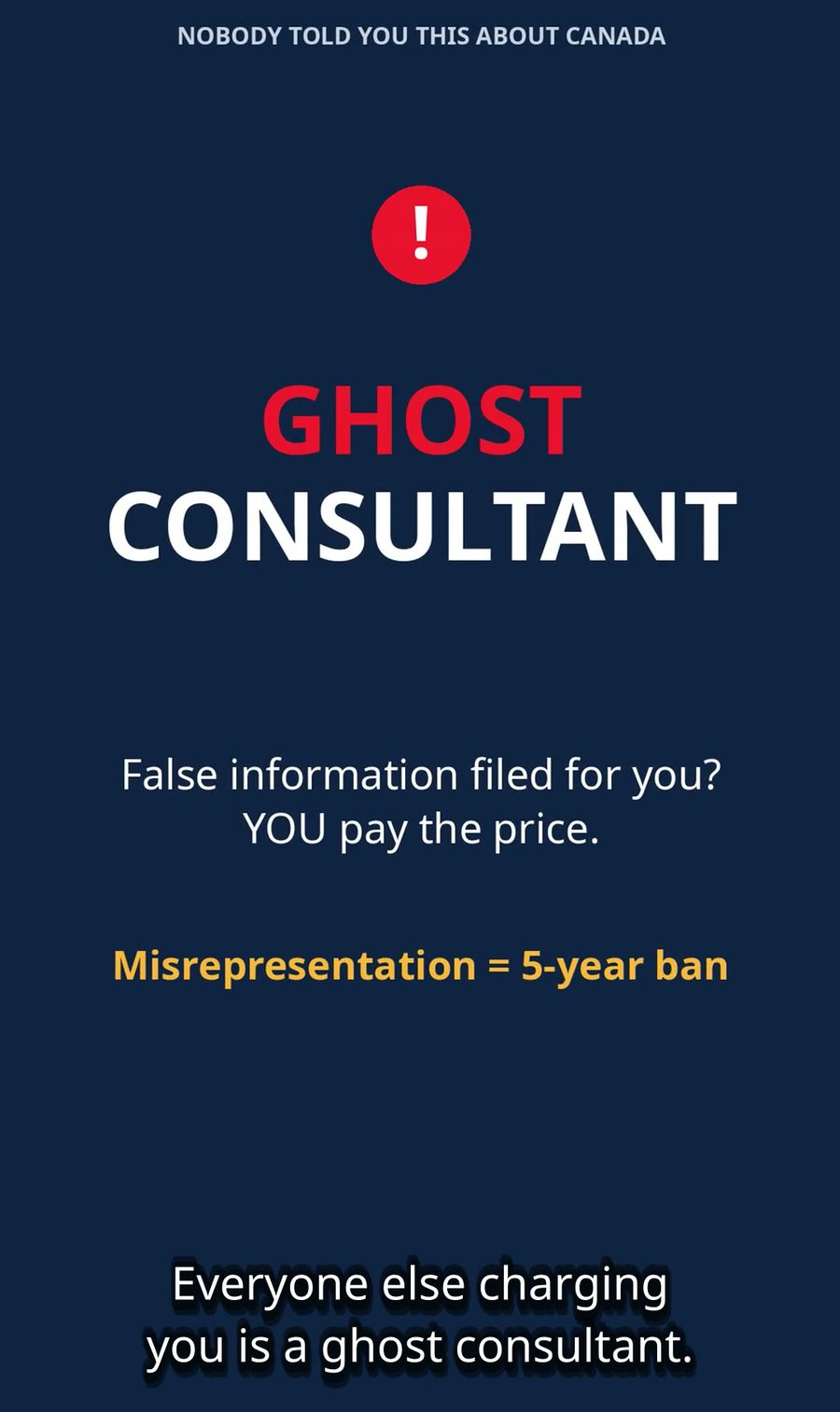
There is a second business hiding inside the first one: immigration advice. In Canada, only three categories of people may legally charge you a fee for immigration advice or representation — a Regulated Canadian Immigration Consultant (RCIC) licensed by the College of Immigration and Citizenship Consultants (CICC), a lawyer in good standing with a provincial law society (Ontario paralegals licensed by the Law Society of Ontario are also authorized), or a Quebec notary. Everyone else charging you for this advice is what the industry calls a ghost consultant: no licence, no regulator, no accountability.
The ghost consultant's trick is simple. They prepare your application, then leave the representative section blank, so the application looks as if it came from you alone. That is deliberate. If the application contains false or exaggerated information, you are the one legally responsible — not them. A finding of misrepresentation can mean refusal, a five-year ban from Canada, and a fraud record that follows every future application. The ghost keeps the fee and disappears. You carry the ban.
The scale of the problem is not small. IRCC refused more than 52,000 temporary residence applications for misrepresentation in just the first six months of 2024, according to figures reported by The Newcomers Pod and cited in the book — compared with roughly 46,000 for the whole of 2023 and about 26,000 for the whole of 2022. Behind many of those refusals is a file someone else prepared.
One scheme, up to 700 students
The most documented case is Brijesh Mishra, a consultant in Jalandhar, Punjab, who ran Education Migration Services. Between 2017 and 2019, he sent hundreds of students from Punjab to Canada carrying acceptance letters he had doctored himself. Reports at the time put the number of students in this single scheme as high as 700. Students arrived in Canada to find they were never enrolled at the colleges named on their letters. Some had already finished degrees at other schools by the time the fraud surfaced — and faced removal anyway.
Mishra pleaded guilty in Vancouver in May 2024 and was sentenced to three years in prison. The students he sent are still paying for it: one student, Ramanjot Brar, completed a tourism degree at St. Lawrence College in 2020 and has since spent roughly $20,000 on immigration lawyers. Broader IRCC findings reported in late 2024 identified roughly 10,000 fraudulent acceptance letters overall, more than 80 percent traced back to consultants operating in Punjab and Gujarat.
The agent keeps the fee and disappears. You carry the ban.

What changed in 2026 — and what it does not cover
There is now a small safety net, but only for people who used a licensed consultant. On July 15, 2026, the CICC's compensation fund opened. If a licensed consultant stole your money or put false information in your application, and the College's Discipline Committee finds a financial loss from a dishonest act on or after November 23, 2021, you can claim up to $7,000. The fund does not cover losses to someone who was never licensed. A ghost consultant's victims get nothing from it — one more reason the register check matters before you pay, not after.
Check before you pay anyone
Two checks, in writing, before any money moves
First, check the person on the CICC public register at register.college-ic.ca — search by name or licence number, and confirm the status reads Active and Entitled to Practise. If they are not on the register, not a lawyer, and not a Quebec notary, they cannot legally charge you for immigration advice. Second, check the school on IRCC's Designated Learning Institutions list, on the PGWP-eligible tab — and ask the school in writing whether your exact program is eligible. Keep every email. Never pay cash without a receipt. Never sign a blank form. Never let anyone submit an application in your name with the representative section left blank.
None of this means every agent is a fraud. Many are honest people doing a real job, and a disclosed commission model can work — the agent tells you who pays them, you judge the advice with that in mind. The test is simple: will they put it in writing? Will they show you their licence? Will they name the schools that pay them? An honest agent answers all three without blinking. The one who cannot answer is the one selling you Canada — and selling you to Canada at the same time.
Sources
- Flywire — International Education Agents 101 — 97% paid by institutions (BUILA & UUKi)
- GradPilot — US Universities Pay Indian Agents to Fill Seats — Mishra charges, guilty plea, 3-year sentence
- Immigration2Canada — IRCC Warns About Unauthorized Immigration Practitioners — IRPA s.91, five-year ban, compensation fund
- The Canadian Life — How to check an immigration representative — CICC register, ghost consultants, fund rules
- Canada Immigration DIY — How to Verify a Canadian Immigration Consultant — register search, $7,000 fund cap