Article
Same Degree. Half the Pay.
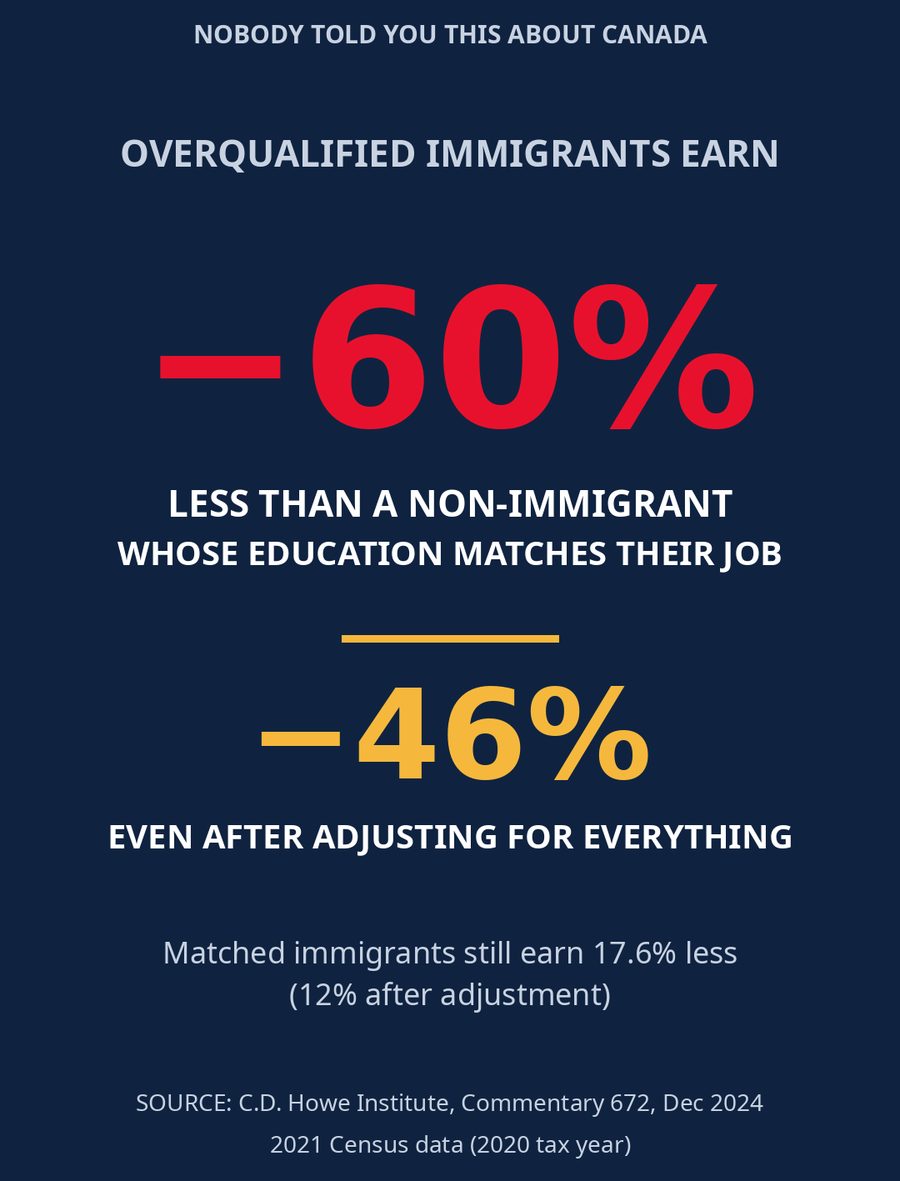
Immigrants in Canada earn 60% less when their education doesn't match their job — and still 46% less after adjusting for everything.

Watch the 60-second video version on YouTube →
Same degree. Half the pay. That is not a slogan — it is the measured gap between an immigrant whose education matches their job and one whose does not, and in Canada that gap is wider than in most countries that compete for the same talent.
The headline number
The C.D. Howe Institute, one of Canada's most cited economic think tanks, measured it in December 2024. Immigrants working in jobs below their education level earn on average 60 per cent less than non-immigrants whose education and skills match their jobs. Adjust for everything you can think of — age, field of study, language, ethnicity, where the degree was earned — and the gap is still 46 per cent. Even immigrants whose jobs do match their education earn 17.6 per cent less than matched non-immigrants, and 12 per cent less after the same adjustments.
Two honest caveats. The earnings analysis runs on the 2021 Census and 2020 tax data — a COVID year, when many service jobs were shut and pay was distorted. The authors themselves warn to interpret the numbers with caution. The gap is real and large, but it is not a figure frozen in time; newer data may move it.
How common is it?
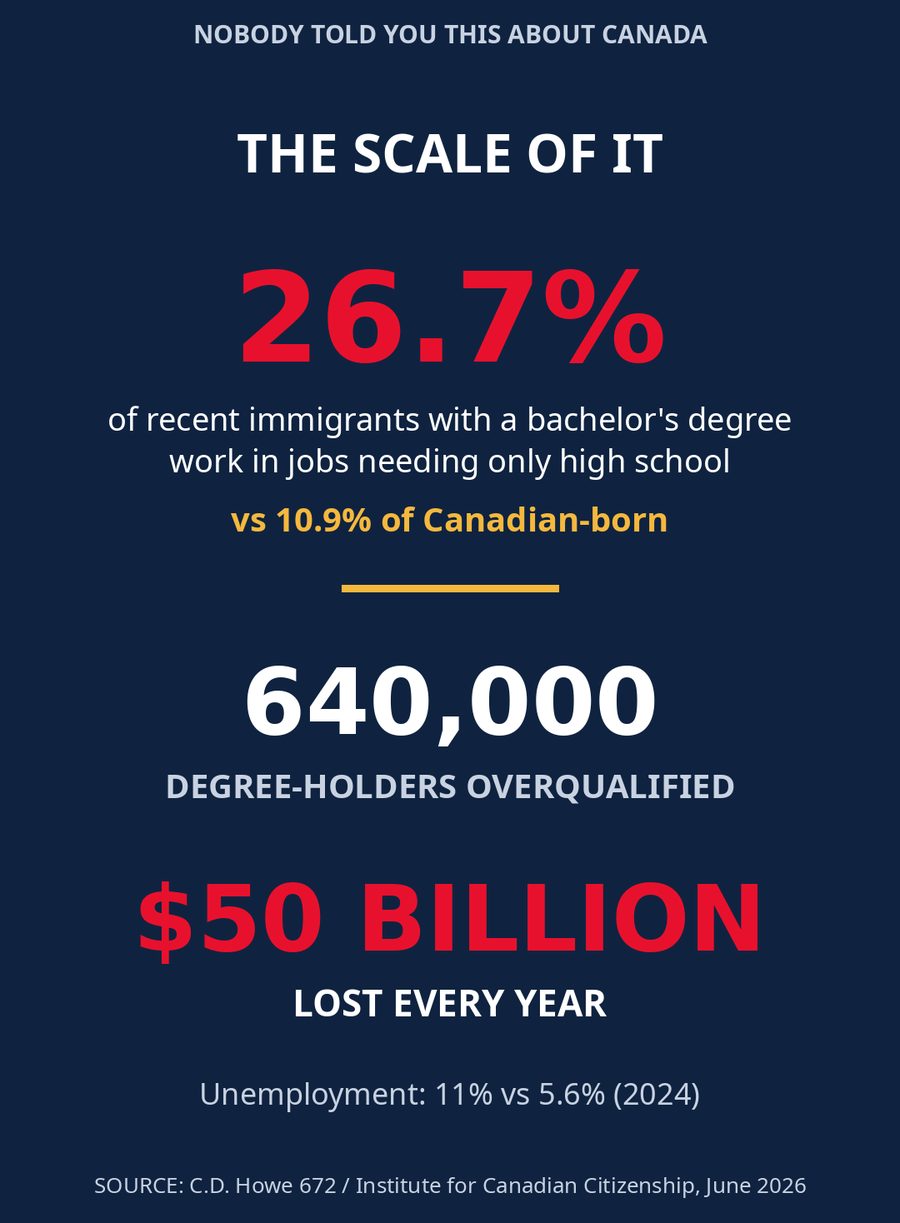
Very. Statistics Canada found that 32.6 per cent of core-aged recent immigrants with postsecondary qualifications said they were overqualified for their jobs, against 19.1 per cent of Canadian-born workers. Among recent immigrants who arrived within the previous five years and held a bachelor's degree or more, 26.7 per cent worked in jobs requiring only a high-school diploma or less, compared with 10.9 per cent of Canadian-born workers. Only 44 per cent of immigrants who arrived within the previous decade were employed in jobs matching their education level, against 64 per cent of Canadian-born workers aged 25 to 34. And one in five recent immigrants was working outside their field of study entirely, against 15.1 per cent of Canadian-born workers.
The gap does not fall evenly. Immigrants educated in Southeast and Southern Asia are 2.7 times more likely to be overqualified than immigrants educated in Canada — the same degrees, earned in the countries Canada recruits hardest from, discounted the most once they land. And in 2024, recent immigrants faced an unemployment rate of about 11 per cent, roughly double the 5.6 per cent rate for Canadian-born workers.
Survival jobs
Newcomers have a name for the work they take while their degrees wait: survival jobs. Taxi. Cleaning. Warehouse. Retail. Nothing wrong with honest work — the problem is the trap, not the job. A survival job pays the rent this month, but it eats the hours you need to study for licensing exams, take bridging courses, and build the professional network that gets you back into your field. The longer you stay, the harder the return gets, because every year in a survival job is a year your professional experience goes stale.
Statistics Canada's study of newcomers who arrived between 2010 and 2020 makes the cost concrete: only one in five was working in the specific occupation they had trained for by 2021, and those who matched their intended occupation earned a median $65,600, against $44,000 for those who did not. The gap between the two lives is about $21,600 a year — every year.

Degrees in the drawer, rent due on Friday.
The scale of the waste
The Institute for Canadian Citizenship counted roughly 640,000 immigrant degree-holders overqualified for their current jobs in 2026 — almost 26 per cent of them, against 11 per cent of Canadian-born degree-holders — and put the cost of foreign qualification barriers at up to $50 billion a year in lost economic potential. This is not only a newcomer's problem. It is a country short of doctors, nurses, engineers, and tradespeople, paying to import the very skills it then refuses to use.
And people notice. About one in five immigrants leaves Canada within 25 years of arriving, and the highly educated leave fastest. Canada is not only wasting the talent it attracts — it is losing it to countries that let people work in the fields they trained for.
Why it happens
There is no single villain. The reasons stack. Licensing is split across roughly 500 separate bodies, each run by its own province and profession, and recognition of a foreign credential is slow, expensive, and often partial. Employers ask for Canadian experience — a requirement Ontario's Human Rights Commission has treated as discrimination since 2013, and which Ontario employers with 25 or more staff may no longer put in job postings as of January 1, 2026 — but the practice has not disappeared from hiring rooms. Language matters, even for fluent speakers, when the accent is unfamiliar. And professional networks take years to build: the referrals, the references, the someone who vouches for you.
None of this is a reason to give up. It is a reason to plan. The newcomer who checks the licensing path before arriving, who starts the credential assessment early, who finds the bridging program and the settlement employment service in the first month — that newcomer has a real chance of beating the average. The one who arrives hoping the degree will speak for itself is the one the statistics are written about.
What to do about it
Check your licence path before you move, on the regulator's own website, in writing. Ask settlement services about bridging programs for your profession — they exist in most large cities and are free. Look into federal Foreign Credential Recognition Loans of up to $30,000 if exam and course costs are the blocker. And know that Ottawa has finally put money behind the problem: Budget 2025 created a $97 million fund over five years to push provinces toward faster, fairer recognition, starting with health and construction. It will not fix the gap overnight. But the gap is now measured, named, and — slowly — on the agenda.
The three checks before you arrive
One: is your occupation regulated in your province, and what does the regulator require? Two: will your credentials be assessed before you arrive, or only after? Three: what is your plan for the first six months — the bridging course, the exam date, the settlement employment service — so a survival job stays a bridge and not a trap?
Sources
- C.D. Howe Institute, Commentary 672 (Dec 2024) — 60% / 46% / 17.6% earnings gaps, 26.7% vs 10.9%
- Statistics Canada, Apr 7, 2026 — 32.6% vs 19.1% overqualified, 25.6% in high-school jobs, field mismatch 20.2% vs 15.1%
- The Conversation, Feb 19, 2025 — 44% vs 64% job-education match; recent immigrant unemployment 11% vs 5.6% Canadian-born
- Institute for Canadian Citizenship, June 2026 — 640,000 overqualified, $50B/year
- Institute for Canadian Citizenship / Conference Board of Canada, "The Leaky Bucket 2025" — 1 in 5 immigrants leave within 25 years
- Statistics Canada study — 1 in 5 in intended occupation, $65,600 vs $44,000
- Canada.ca — $97M Foreign Credential Recognition Action Fund, Budget 2025