Article
Your Nigerian Degree Can Be Worth $0 in Canada
An ECA is not a licence. Here are the roads through the gate — nursing, engineering, medicine — with timelines and costs.
Watch the 60-second video version on YouTube →
You spent years earning your degree. It opened every door at home. In Canada, it can be worth exactly nothing — not because you did not work for it, but because you are holding the wrong key.
Can you get a job in Canada without PR?
Short answer: yes for some jobs, no for others — and the split matters more than your visa status. About one in five jobs in Canada is regulated by law: doctor, nurse, engineer, teacher, accountant, licensed trades. For those jobs you need a licence from a provincial regulator before you can work under the title, whatever your immigration status. The other four in five jobs are decided by the employer. No licence is needed — the employer looks at your CV, your references, and whether they trust what your degree means.
So there are two different permissions, and newcomers mix them up. A work permit or permanent residence lets you work in Canada. A licence lets you practise a regulated profession in Canada. One does not give you the other. You can hold PR and still be barred from your profession for years. You can also work legally from your first week — just not in the job you trained for.
An ECA is not a licence
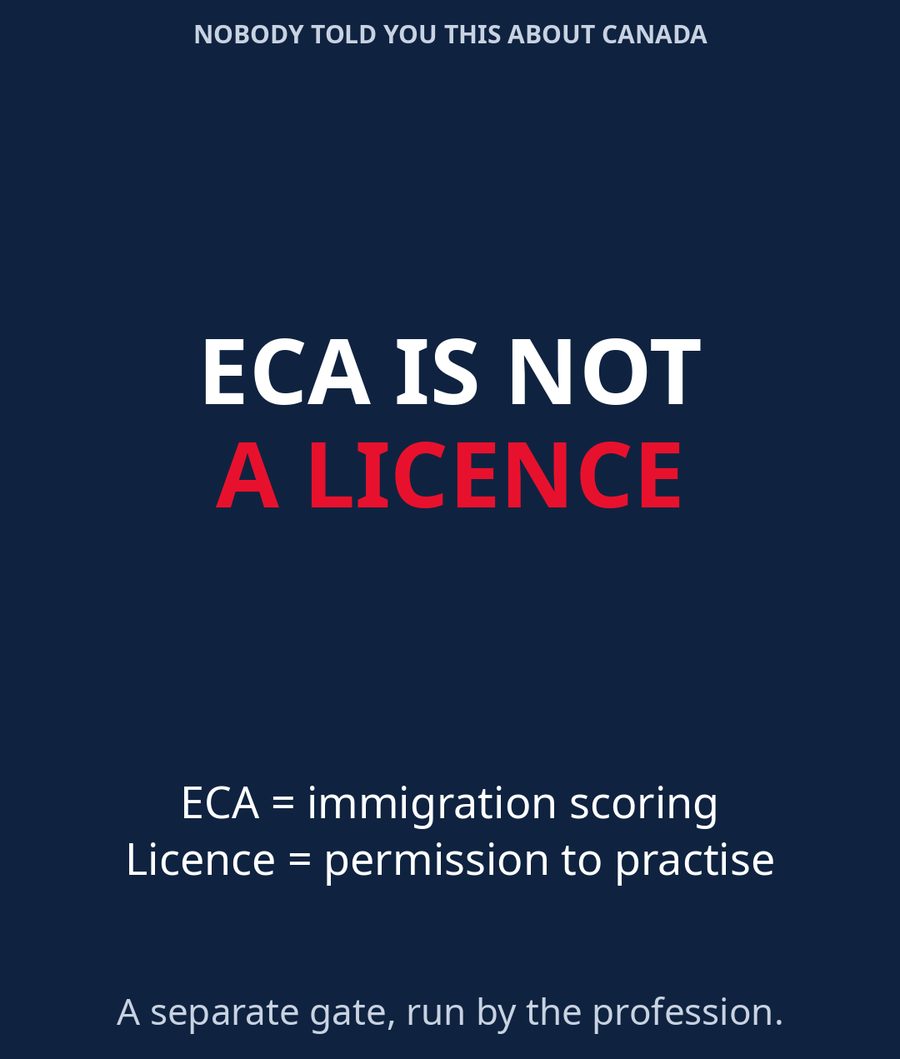
An Educational Credential Assessment — an ECA, usually done by WES — tells immigration roughly what your degree is worth on the Canadian scale. That is all it does. It scores your education for Express Entry points. It does not let you practise. Licensing is a separate gate, run by the profession itself, province by province.
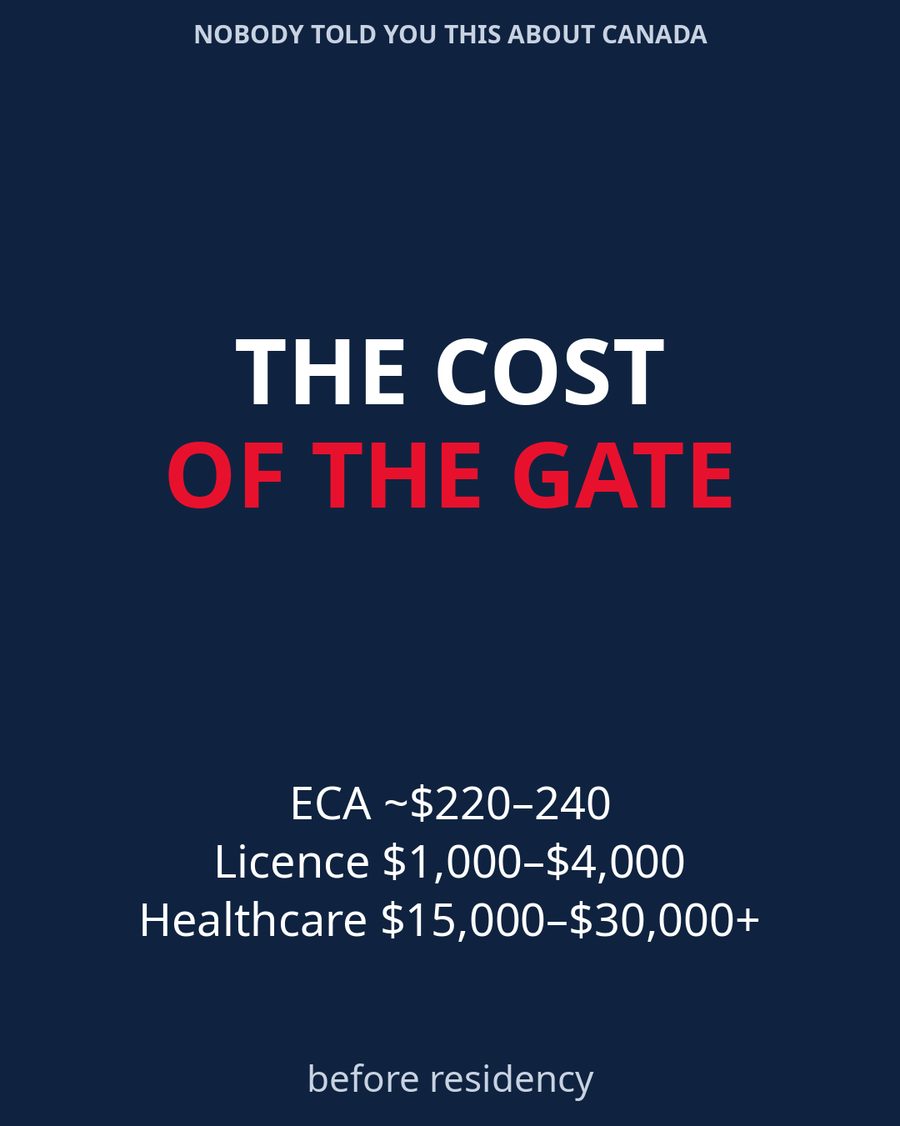
The ECA itself is the cheapest step: WES charges $264 in 2026, plus delivery and tax, and the report is valid for five years; other designated organisations charge roughly $200 to $260. Pay it when immigration asks for it. Just do not mistake the receipt for a licence — that mistake is how doctors end up driving Ubers.
The five roads through the gate
Every regulated profession has its own road, its own timeline, and its own price. Here are the five the book profiles, updated with what we verified.
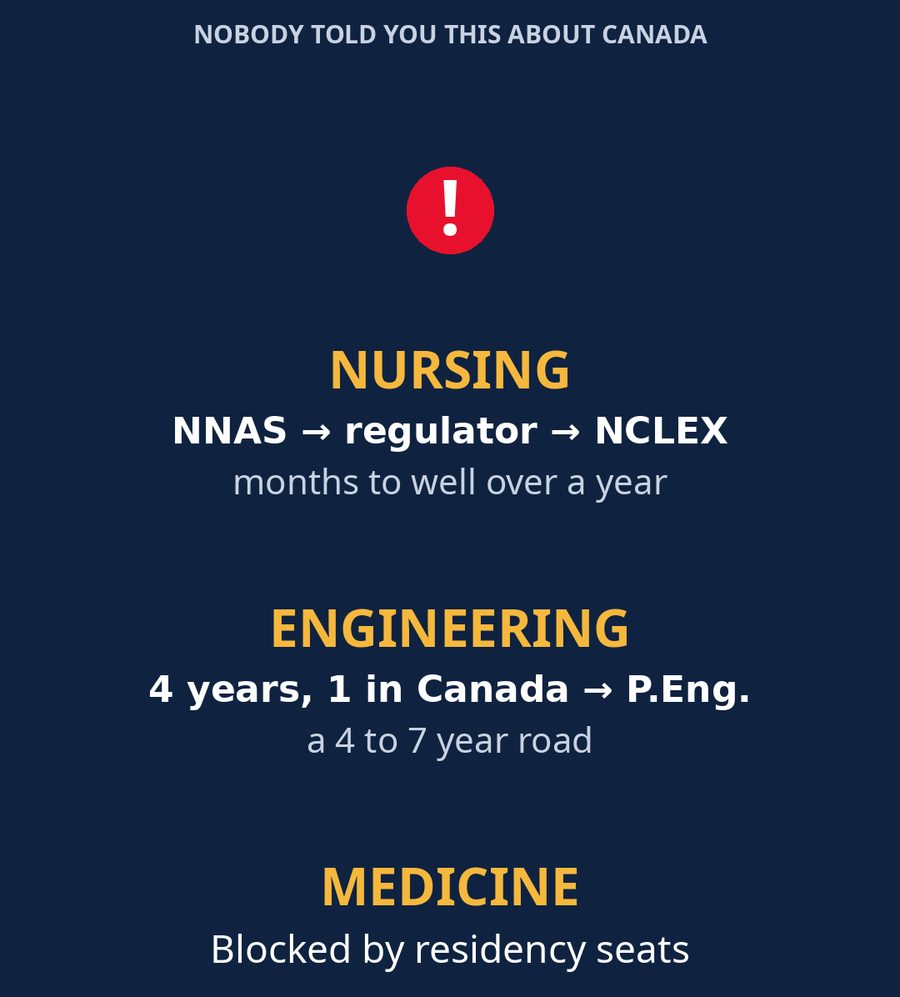
Nursing. For internationally educated nurses, the first mandatory step — everywhere except Quebec and the territories — is the National Nursing Assessment Service, NNAS. It checks your education and issues an advisory report to your provincial regulator, which then decides whether you go straight to the licensing exam, the NCLEX-RN, or need bridging courses first. The NNAS step alone typically takes 6 to 18 months, mostly waiting on documents from your school and licensing body back home.
Engineering. Most regulators still require about four years of engineering experience before they grant the P.Eng. title. But the rules moved in 2026: Ontario cut its minimum to 24 months on July 1, 2026, and most regulators have replaced the old "one year in Canada" rule with Canadian-environment competencies — skills you demonstrate, not a calendar year you serve. The academic assessment and competency review take their own time, and the rules are no longer the same everywhere — check your province's regulator.
Medicine. For doctors, the bottleneck is not the exams — it is getting a residency seat. Only 24 per cent of international graduates match to a residency spot of their choice, against 92 per cent of Canadian graduates. The exam and application fees alone add up before you ever reach a hospital: about $1,500 for the qualifying exam, $3,320 for the clinical skills exam, and several hundred more for the match application and credential verification — roughly $5,640 in fees before travel, preparation courses, or a single month of living costs.
Accounting and law. Accounting is the shortest road the book profiles — requalification in as little as two to three months where a mutual recognition agreement exists between CPA Canada and your home country's body. Law outside Quebec runs through the National Committee on Accreditation, with its own exams before articling and the bar. Quebec law is a separate civil-law system with its own equivalence process — check the Barreau du Québec directly rather than trusting any single number.
The cost of the gate
The ECA is the small bill. The book puts licensing itself at typically $1,000 to $4,000 for most regulated professions, and $15,000 to $30,000 in healthcare fields before residency — a range that covers exams, preparation, travel, and months of living without a professional income. Treat those as planning ranges, not quotes: the only exact numbers are the ones your regulator publishes.
Two things soften the cost: federal Foreign Credential Recognition Loans of up to $30,000 cover exam fees, training, and related costs. And Budget 2025 created a $97 million Foreign Credential Recognition Action Fund over five years, starting in 2026-27, to push provinces to make recognition fairer, faster, and more transparent, starting with health and construction. It does not write cheques to applicants, and most effects arrive between 2027 and 2029 — but it is the first time Ottawa has put real money behind fixing the gate itself.
And the gate does not always open even when you pay. Of working-age immigrants who applied for a licence in a regulated occupation using foreign credentials, only 42.7 per cent had them fully recognised by late 2024. Another 34 per cent got partial recognition — more courses, more waiting. A Statistics Canada study of newcomers admitted between 2010 and 2020 found only one in five was working in the specific occupation they had trained for by 2021. Those who matched their intended occupation earned a median $65,600, against $44,000 for those who did not. The gap between the two lives is about $21,600 a year.
The job market you cannot see
There is a second gate after the licence, and it has no form to fill in. You have probably read that 70 to 80 per cent of Canadian jobs are never posted. We checked that number before writing this article, and we could not verify it — it traces back to old pre-internet research, and recruiters today put truly never-posted roles far lower. What Statistics Canada's own survey does show is nearly as important: in late 2024, employers used personal contacts, referrals, and informal networks in 72.5 per cent of their hiring efforts. And referred candidates are about seven times more likely to be hired than people who apply cold, according to an analysis of 4.5 million applications.
That is the hidden market as it actually works: jobs that go to people the employer already knows or who were recommended by someone trusted. A newcomer with no Canadian network starts that race from behind. The fix is unglamorous — professional associations, mentoring programs, settlement employment services, informational interviews — but it is the fix that works, and it costs nothing but time.
The open doors
Not every road has a gate. Four in five jobs are not regulated, and in those the employer decides. The skilled trades mostly skip the credential wall too: electricians, welders, plumbers and mechanics qualify through paid apprenticeship and a Red Seal certification that is recognised in every province. The door you walk through matters more than the degree you carry — and you can check which door is yours before you pack a bag.
Check your road before you pay anyone
First, find out whether your occupation is regulated in your province — CICIC's directory lists every occupation and its regulator. Second, read the regulator's pathway page and ask for the current timeline and fees in writing. Third, never pay an agent who promises a licence or a job: licensing comes only from the regulator, and only a licensed immigration consultant, a lawyer, or a Quebec notary may legally charge for immigration advice.
Sources
- CICIC — about 20% of jobs are regulated; ECA is not a licence
- WES ECA fee C$264 in 2026, via GoFarGlobal
- NNAS first step for internationally educated nurses, 6–18 months
- P.Eng. requirements by regulator, 2026 — Ontario 24 months, most others 48
- College of Family Physicians of Canada — 24% vs 92% residency match
- MCC and CaRMS fee schedules 2026-27 — IMG exam costs
- Statistics Canada, Apr 7, 2026 — 42.7% full recognition
- Statistics Canada study — only 1 in 5 newcomers work in their intended occupation
- The 70–80% hidden-job-market claim, examined — and the referral data
- Canada.ca — $97M Foreign Credential Recognition Action Fund, Budget 2025