Article
Your Uber Driver Was a Doctor
Ismelda Ramirez trained as a family doctor. In Quebec she worked eight months at McDonald's.
Watch the 60-second video version on YouTube →
Next time you get in an Uber in Toronto, ask the driver what they studied. You might be sitting behind a doctor. That is not a joke and it is not a guess — it is what Canada's own numbers describe, and it starts with a real woman whose name we know.
A real case, with a name
Ismelda Ramirez trained as a family doctor in the Dominican Republic. She moved to Quebec in 2022. She spent eight months working at McDonald's. Her words, to CBC News in January 2025: "I never expected to swap my white doctor's coat for a McDonald's uniform."
She did everything the system asked. She passed her Canadian qualifying exams. Then she hit the wall that stops most foreign-trained doctors in Canada: she could not get a residency seat — the hospital training post a doctor must complete before they can practise. She was not selected, and she says she received no feedback on how to improve her application. At the time of the CBC story she was working as a medical assistant in Quebec, still waiting.
A Quebec non-profit, Les Anges de L'Espoir, has helped more than 1,100 internationally trained physicians since 2016. It says only about 10 per cent of them have been licensed. Ramirez is not an exception. She is the normal outcome of a system built this way.
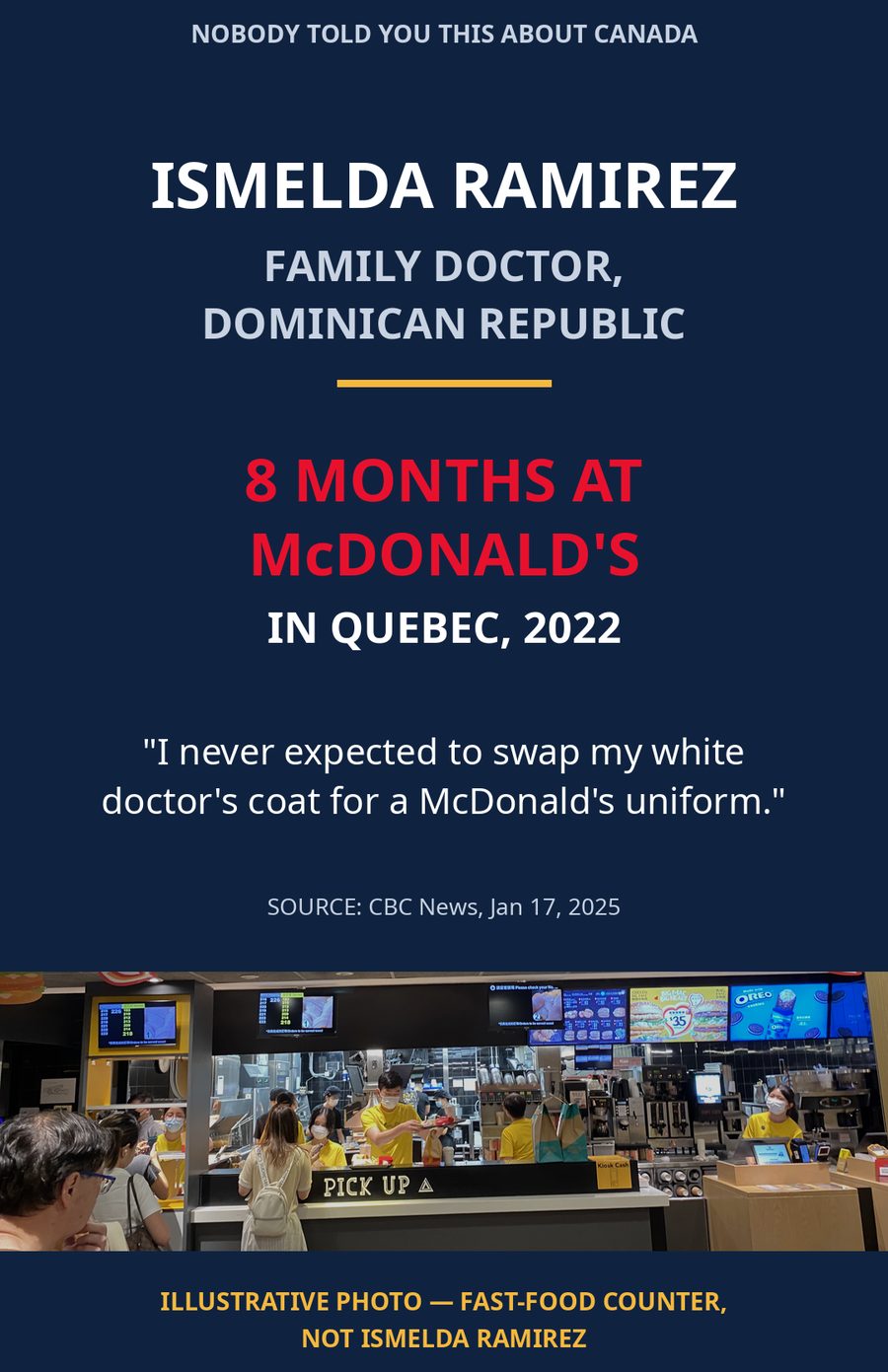
"I never expected to swap my white doctor's coat for a McDonald's uniform." — Ismelda Ramirez, to CBC News
The residency wall
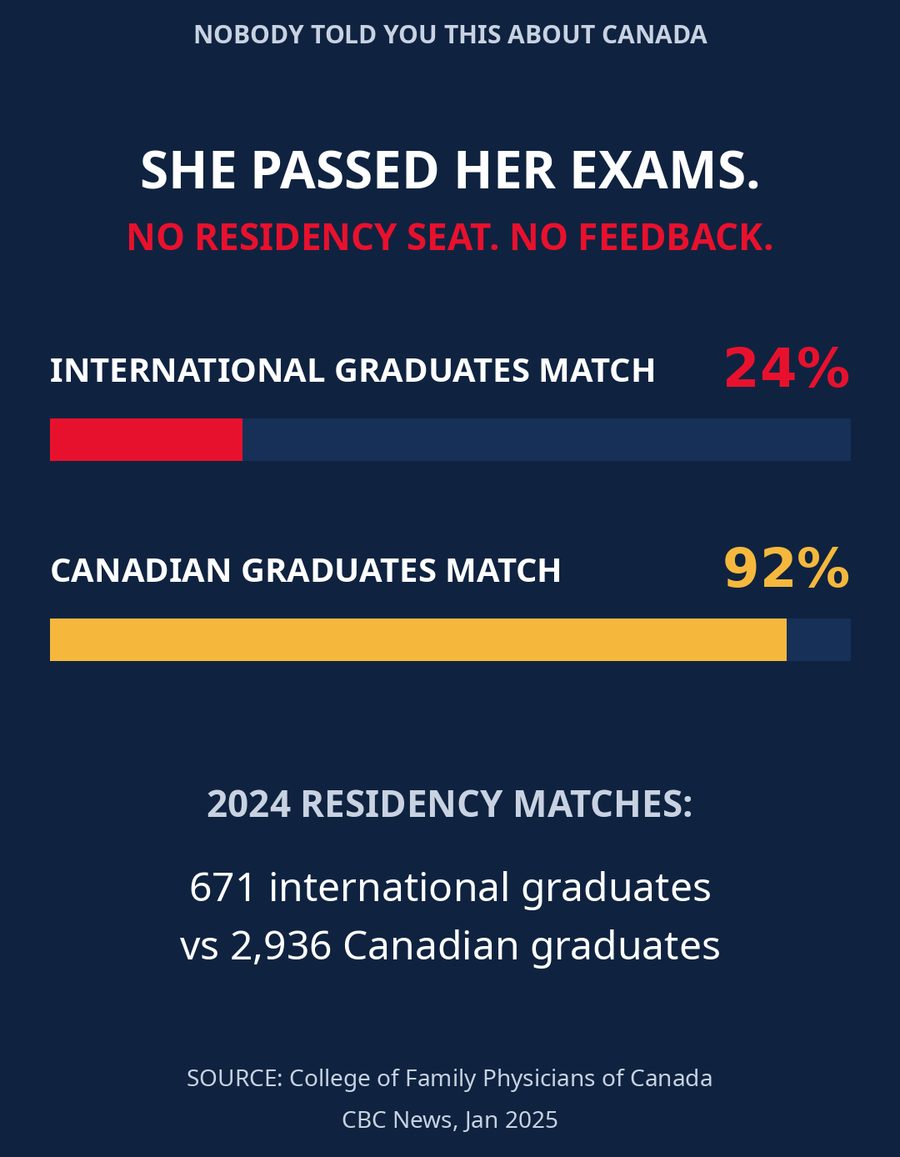
The bottleneck for a foreign-trained doctor is not the exams. It is the residency seat. Dr. Carrie Bernard, president of the College of Family Physicians of Canada, told Parliament's Health Committee that while 92 per cent of Canadian medical graduates match to a residency spot of their choice, only 24 per cent of international graduates do. In 2024, the numbers behind that gap were 671 international graduates matched, against 2,936 Canadian graduates.
The number is moving, and fairness requires saying so: 931 international medical graduates matched in 2026, up from 851 in 2025 and 671 in 2024. But the gap is still wide, and the same testimony put the scale of the need in plain terms — Canada is almost 23,000 family doctors short, and international graduates already make up 31 per cent of the family doctors practising in the country. The system depends on the very people it keeps waiting.
She is not alone
Statistics Canada's 2021 Census measured the same story across the whole country. Only 41.1 per cent of immigrants with a foreign medical degree worked as doctors. Only 36.5 per cent of immigrants with a foreign degree in registered nursing worked as registered nurses. For Canadians who earned their degrees in Canada, about 9 in 10 worked in their field — 87.4 per cent of nurses and 90.1 per cent of doctors.
The gate is not only about doctors. Of working-age immigrants who applied for a licence in a regulated occupation using foreign credentials, only 42.7 per cent had their qualifications fully recognised by the third quarter of 2024; another 34 per cent got only partial recognition, meaning more courses and more waiting. And nearly one in three recent immigrants with postsecondary qualifications — 32.6 per cent — told Statistics Canada they were overqualified for the job they held, against 19.1 per cent of Canadian-born workers.
The shortage next door
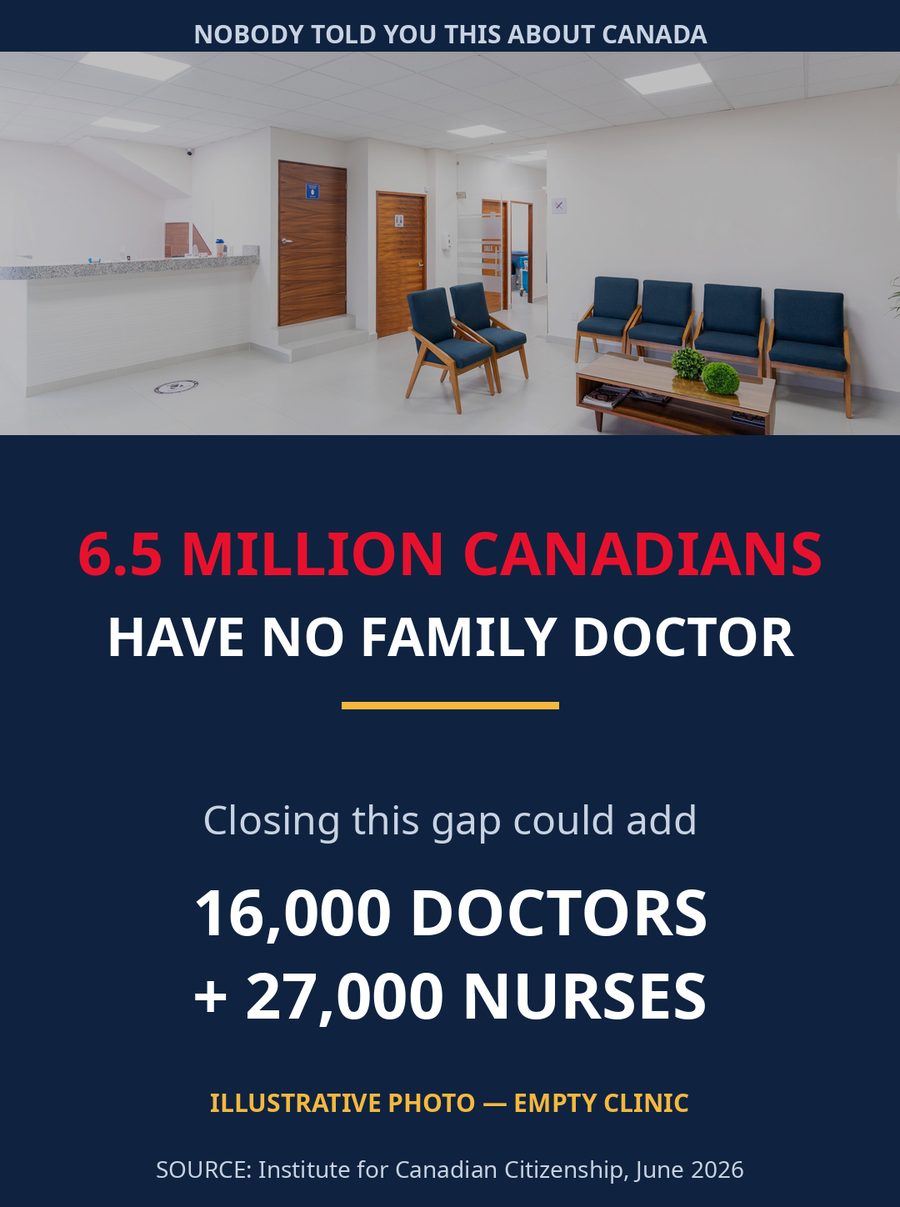
Here is the part that makes the story hard to accept: 6.5 million Canadians have no family doctor. The Institute for Canadian Citizenship calculated in June 2026 that closing the overqualification gap could add roughly 16,000 doctors and 27,000 nurses and related professionals to the workforce — people already living in Canada — without growing the population at all. About 640,000 immigrant degree-holders are overqualified for their current jobs, almost 26 per cent, more than double the 11 per cent rate among Canadian-born workers. The same report puts the cost of foreign qualification barriers at up to $50 billion a year in lost economic potential, spread across roughly 500 separate licensing bodies, each run by its own province and profession.
The catch-22
Canada gives your degree points at the border. Under Express Entry, education is worth up to 150 points for a doctorate, 135 for a master's, 120 for a bachelor's — as long as you have an Educational Credential Assessment to prove it. Then comes the catch: no licence without Canadian experience, no Canadian experience without a licence. In Ontario, the Human Rights Commission has treated a strict "Canadian experience" requirement as discrimination since 2013, and since January 1, 2026, Ontario employers with 25 or more employees may not put Canadian-experience requirements in job postings at all. That helps with job ads. It does not open the licensing gate, which is run by the professions, province by province.
So the honest advice is to check your road before you pack a bag. A doctor's road runs through the Medical Council of Canada's exams, then the CaRMS residency match — whose international stream generally requires Canadian citizenship or permanent residence — then the provincial regulator. A nurse's road runs through the National Nursing Assessment Service, then the provincial college, then the licensing exam. Each step has its own timeline, its own fees, and its own waiting list. Know them all before you decide, not after you arrive.
Before you move as a doctor or nurse
Check the licensing path for your exact profession and province on the regulator's own website — not an agent's brochure. Confirm whether you can enter the CaRMS match from your immigration status. Ask the regulator in writing how long each step takes, and budget for years, not months. Practice-ready assessment programs exist in some provinces for experienced doctors; ask the regulator whether you qualify.
Sources
- CBC News, Jan 17, 2025 — the Ismelda Ramirez story, 671 vs 2,936 residency matches
- College of Family Physicians of Canada, Health Committee testimony — 24% vs 92% match, 23,000 doctors short
- Statistics Canada, 2021 Census (The Daily, Nov 30, 2022) — 41.1% doctors, 36.5% nurses
- Statistics Canada, Apr 7, 2026 — 32.6% overqualified, 42.7% full recognition
- Institute for Canadian Citizenship, June 2026 — 6.5M without a family doctor, 16,000 doctors + 27,000 nurses, $50B
- CaRMS 2026 match results — 931 international graduates matched
- IRCC Comprehensive Ranking System criteria — education points up to 150
- Ontario Human Rights Commission, 2013 — "Canadian experience" policy